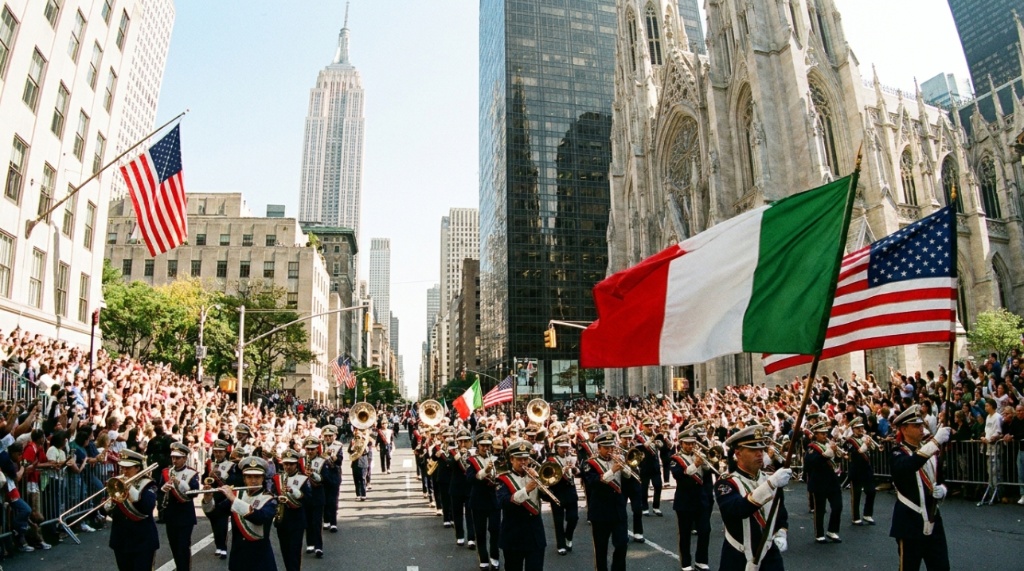
The 82nd Annual NYC Columbus Day Parade returns on Monday, October 12, 2026, running along Fifth Avenue from 42nd Street to 72nd Street from roughly 11:30 a.m. to 3:30 p.m. Formation happens on 43rd–47th Streets, and the crowd disperses between 72nd and 79th Streets. Plan to take the subway, pick a viewing spot early, and expect Fifth Avenue closed to traffic for most of the day.
Every October, roughly 35,000 marchers and up to a million spectators turn Fifth Avenue into the center of New York’s Italian-American community for a day. If you’ve searched “NYC Columbus Day Parade,” you’ve probably found a handful of pages that all repeat the same three facts and stop there. This guide is the opposite: it covers the date, the full route, every stretch of street closures, how to actually get there, where to stand, who’s marching, and what the parade means—everything you need to plan the day from start to finish in one place.
| Event | Details |
|---|---|
| Date | Monday, October 12, 2026 |
| Time | 11:30 a.m.–3:30 p.m. |
| Route | Fifth Avenue (42nd–72nd Street) |
| Cost | Free |
| Organizer | Columbus Citizens Foundation |
When Is the NYC Columbus Day Parade in 2026?
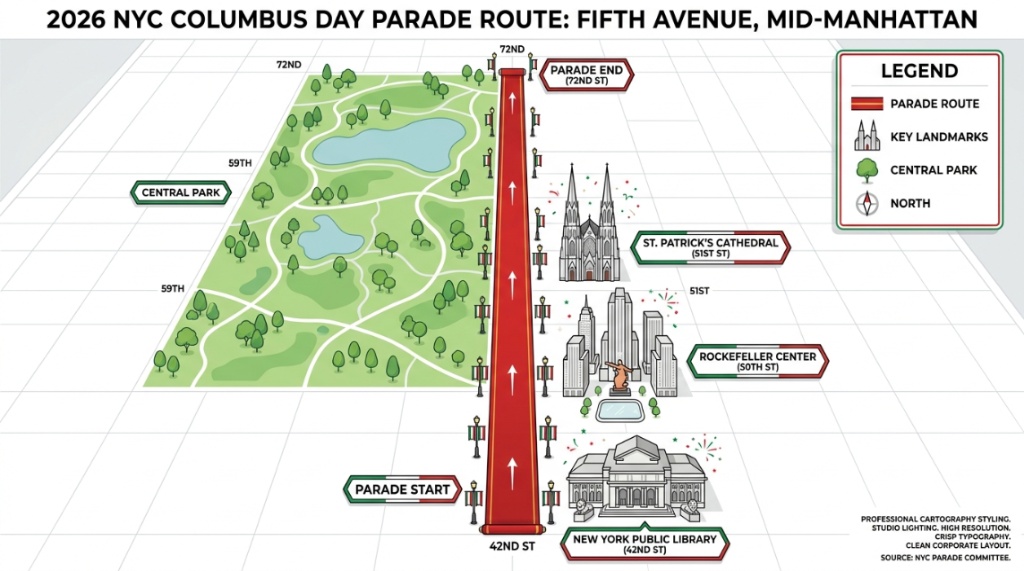
The parade steps off on Monday, October 12, 2026, which is also the federal Columbus Day holiday. The start time is 11:30 a.m., and the full procession bands, floats, cultural organizations, and tens of thousands of marchers typically takes about four hours to fully pass, wrapping up around 3:30 p.m.
- Date: Monday, October 12, 2026
- Time: 11:30 a.m. – approximately 3:30 p.m.
- Route: Fifth Avenue, 42nd Street to 72nd Street
- Line-up area: 43rd–47th Streets, Madison to Fifth/Sixth Avenue
- Organizer: Columbus Citizens Foundation
- Cost to attend: Free, no tickets required
Because the holiday lands on a Monday in 2026, expect a mix of dedicated attendees and people extending their weekend plans. Plan to arrive earlier than you think you need to if you want a good spot anywhere along the route.
From past parade-goer comments, the people who got the best viewing spots usually showed up very early around 6:00 a.m. and said that timing worked well. By contrast, commenters noted that arriving after 7:30 a.m. was often too late if you wanted a front-row spot.
The Full Route, Step by Step
Formation area
Marchers assemble on 43rd through 47th Streets, between Madison Avenue and Fifth/Sixth Avenue, well before the 11:30 a.m. step-off. This is where bands warm up, floats line up, and organizations gather their groups—if you’re marching, this is where your morning starts.
Main route
Once released, the parade moves straight up Fifth Avenue from 42nd Street to 72nd Street—a single unbroken corridor with no turns onto side streets. That makes it one of the more predictable major NYC parades to plan around once you know the line.
Dispersal zone
After 72nd Street, the parade doesn’t just stop—it disperses gradually across Fifth Avenue between 72nd and 79th Streets, along with nearby cross streets toward Madison and Park Avenues. Expect lingering foot traffic in this area even after the last marchers pass, since it takes time for a parade this size to fully clear.
Street Closures: What to Expect
Because a parade this size needs staging room and crowd control space, closures extend well beyond Fifth Avenue itself. Based on the pattern used in recent years, expect something close to this for 2026:
| Zone | Streets Affected | Approximate Closure Window |
|---|---|---|
| Formation area | 43rd–47th Streets, Madison Ave to 5th/6th Ave | ~9 a.m. – 12:30 p.m. |
| Main route | Fifth Avenue, 42nd St to 72nd St | ~10:30 a.m. – 4 p.m. |
| Dispersal zone | Fifth Ave (72nd–79th St) and nearby cross streets | ~12:30 p.m. – 4:30 p.m. |
Official 2026 closures typically aren’t confirmed by NYPD and DOT until one to two weeks before the parade, so treat the table above as a solid planning baseline rather than the final word. If you need the complete block-by-block list—including every secondary cross street the NYPD tends to close at its discretion, plus exact subway station recommendations for each stretch of the route—the full route map and street closures guide breaks it down further than there’s room for here.
Mid-October temperatures in New York are typically cool, so dressing in layers and wearing comfortable walking shoes is recommended.
Visitors using wheelchairs or mobility devices should arrive early to secure accessible viewing locations along wider sections of Fifth Avenue. Nearby subway stations also offer varying levels of elevator access.
Morning sunlight generally falls differently along Fifth Avenue depending on your location, so photographers may prefer arriving early to scout a position before crowds build.
At my viewing spot near a single block on Fifth Avenue, the parade took around half an hour to fully clear the block. The first units arrived in a steady wave; the main body passed in a tighter 10–15-minute burst, and the final marchers and support vehicles lingered afterward.
Getting There: Subway, Bus, and Parking
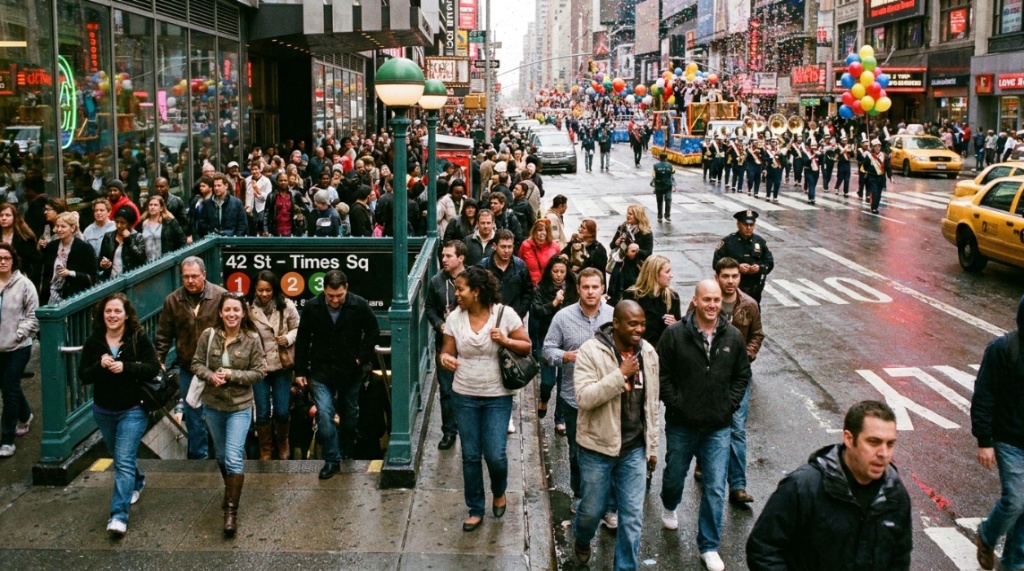
Public transit is the reliable way to reach the parade. A few stations put you within easy walking distance of different stretches of the route:
- B/D/F/M to 47th–50th Streets–Rockefeller Center, for the southern end near the formation area
- N/R/W to Fifth Avenue–59th Street, for the middle of the route
- 4/5/6 to 59th Street, a few avenues east if you want a less crowded walk in
- 6 to 68th Street–Hunter College, for the northern end near the dispersal zone
Getting off one stop away from your target block and walking the last few minutes is usually faster than fighting the crowd at the station closest to the busiest stretch. If you’re driving, plan to park several blocks east or west of Fifth Avenue and walk in—anywhere closer will likely be blocked or gridlocked from rerouted traffic. Rideshare pickups near the route are also unreliable that day; set your pin blocks away rather than right on Fifth Avenue.
People usually don’t pick the closest station they get off one stop away and walk the last few blocks. The walk is generally easy but crowded, and it gets slower the closer you are to the parade route, so a station like 59th Street Columbus Circle or 72nd Street is often a smoother choice than trying to exit right on top of it.
Who’s Marching, and What the Parade Celebrates
The NYC Columbus Day Parade is organized by the Columbus Citizens Foundation and is one of the largest celebrations of Italian-American heritage in the country. Expect marching bands from schools and community groups, elaborate floats tied to Italian-American history and regional culture, civic and cultural organizations marching in traditional dress, and public officials who typically appear near the start of the route. Performances throughout the day highlight Italian-American contributions to art, science, and public life.
NYC Columbus Day Parade itself remains a subject of public debate—some cities now mark the day as Indigenous Peoples’ Day instead of or alongside Columbus Day. The NYC parade, as organized by the Columbus Citizens Foundation, is framed primarily as a celebration of Italian-American identity and community. If you want the fuller story—the parade’s origins, what a first-time attendee should expect, and the related events (a Columbus Circle wreath-laying and a mass at St. Patrick’s Cathedral) that round out the weekend—the history and what-to-expect guide goes into that in more depth.
Where to Watch
Not every block along Fifth Avenue offers the same experience. The stretch near the formation area, roughly 44th to 50th Street, sees the parade at its freshest and draws the biggest, most energetic crowds—arrive well before 11:30 a.m. if you want a curbside spot there. The middle of the route, around 55th to 65th Street, is a reasonable default: still plenty of energy, with noticeably more breathing room. The upper end, closer to 68th–72nd Street near the dispersal zone, is consistently the calmest stretch and tends to work best if you’re bringing young kids or want to avoid standing in a dense crowd for hours.
If you’re planning specifically around a family visit—stroller access, realistic bathroom break logistics, what to bring for younger kids—the best viewing spots guide covers that in more detail than fits in a planning overview.
I personally got the best view standing on the southeast corner of Fifth Avenue and 59th Street (at the Plaza Hotel / Grand Army Plaza area).
Pre-Parade Checklist
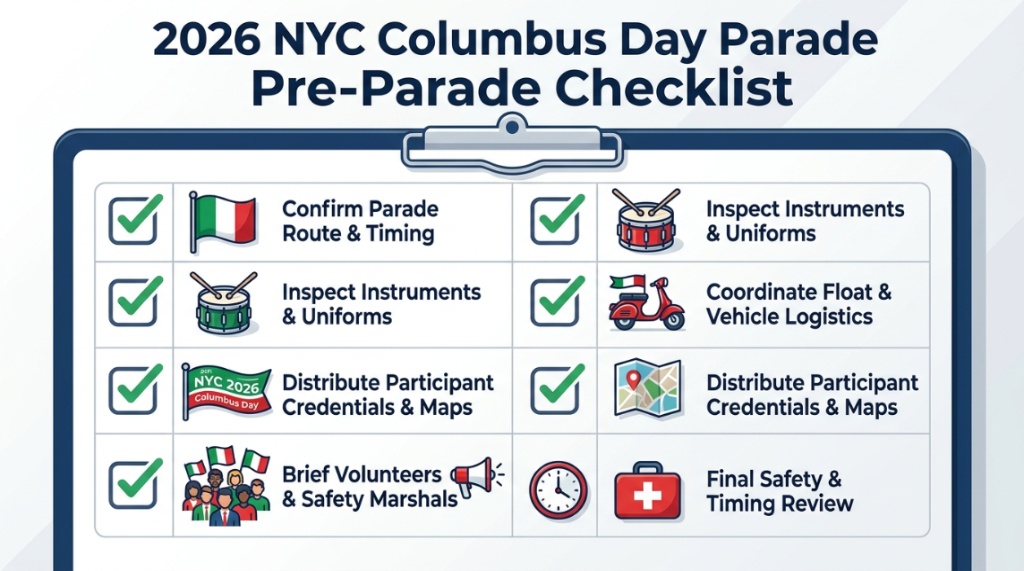
- Confirm the date: Monday, October 12, 2026, 11:30 a.m. step-off
- Pick a specific viewing spot in advance rather than deciding on the day
- Plan your subway route and pick a station a block or two off the busiest stretch
- Check the weather—mid-October in NYC can be chilly, and you’ll likely be standing for a while
- Agree on a meeting point with your group in case you get separated
- If you’re bringing kids, review the family-friendly viewing spots ahead of time
- Confirm your route home in advance—dispersal-zone streets can stay closed later than the main route
One thing I wish I’d packed or planned for: a portable charger, because once you’ve got a good viewing spot, you don’t want to leave it just to find a dead phone or a bathroom.
Common Mistakes to Avoid
- Assuming you can drive through: Fifth Avenue and many cross streets are closed for most of the day—plan on transit or walking.
- Showing up right at 11:30 a.m.: Good spots along the route fill up well before step-off, especially near the middle and lower parts of the route.
- Relying on last year’s exact closure list without double-checking: The route is consistent year to year, but always confirm current-year details closer to the date.
- Not checking the weather: You’ll likely be standing outside for an hour or more—dress for it.
- Picking the busiest stretch with young kids: The energy near the formation area is fun, but it can be overwhelming for small children—the upper route is usually easier.
Frequently Asked Questions
What time does the NYC Columbus Day Parade start in 2026?
The parade steps off at 11:30 a.m. on Monday, October 12, 2026, and typically runs until around 3:30 p.m.
Where does the Columbus Day Parade take place?
It runs along Fifth Avenue in Manhattan, from 42nd Street to 72nd Street, with formation on 43rd–47th Streets and dispersal between 72nd and 79th Streets.
Is the Columbus Day Parade free to attend?
Yes. Watching from the street is free, and no tickets are required.
Will streets be closed on Columbus Day 2026 in NYC?
Yes—Fifth Avenue between 42nd and 72nd Streets closes for most of the day, along with several cross streets used for formation and dispersal. Official 2026 closures are typically confirmed one to two weeks before the parade.
Is the parade good for kids?
It can be if you pick the right spot and time—the upper stretch of the route, closer to the dispersal zone, tends to be far less crowded than the areas near the formation zone.
What is the Columbus Day Parade actually celebrating?
It’s primarily a celebration of Italian-American heritage and community, organized by the Columbus Citizens Foundation, rather than a historical commemoration focused narrowly on Columbus’s voyages.
Is the parade broadcast on TV?
In recent years the parade has aired on local NYC television around midday—check listings closer to October 2026 for the current year’s broadcast schedule.
How long does the parade actually last?
The full procession typically runs about four hours from step-off to the last marchers clearing the route, though any single spot along Fifth Avenue will see the parade pass for a shorter window than that.
Planning more of your October in New York? Check out newyorkbigevent.com’s guides to other fall NYC parades and events.
For final schedules, route updates, and any last-minute announcements, check the official Columbus Citizens Foundation and NYC Department of Transportation notices before attending.