New York City is cinema’s most iconic backdrop, featured in over 250,000 films since 1896. Whether you want to discover the best NYC movies across every genre, visit famous filming locations like Central Park and the Ghostbusters firehouse, catch films at historic theaters from Radio City Music Hall to indie gems like Metro graph, attend world-class festivals (NYFF, Tribeca), or understand how the birthplace of American cinema became Hollywood’s favorite on-location city — this guide covers it all. NYC offers everything from free outdoor screenings in Bryant Park to discounted movie tickets through AMC A-List, plus behind-the-scenes insights into how modern productions actually work in the city. This is your complete resource for experiencing New York through the lens of cinema.
Why New York City Is Cinema’s Favorite City
After Los Angeles, New York City ranks as the second-most filmed city globally, but it holds a unique distinction LA cannot claim: NYC is where American cinema was born. Long before Hollywood became synonymous with movies, New York was the center of the film universe. From 1900 to 1920, most major film studios operated in and around Manhattan, with early pioneers like Thomas Edison filming on New York streets and rooftops decades before the first Hollywood studio opened.
What makes NYC cinematically special isn’t just history — it’s versatility. The city’s diverse neighborhoods, iconic landmarks, and architectural variety allow directors to tell every kind of story. Times Square can play gritty and dangerous (Taxi Driver, 1976) or glittering and magical (Elf, 2003). Greenwich Village brownstones evoke romance and bohemian charm. The Financial District’s canyon of skyscrapers becomes the perfect backdrop for crime thrillers and superhero battles. Brooklyn’s industrial waterfronts and gentrified neighborhoods add contemporary edge.
Unlike studio backlots,
New York provides authenticity and energy no set can replicate. The city itself becomes a character — shaping stories, driving plots, and giving films a sense of place you can feel. Directors from Martin Scorsese to Spike Lee to Greta Gerwig have built entire careers exploring different facets of New York on film, each finding new angles on streets filmed thousands of times before.
Local Perspective: The first time I stepped out of the subway station into Washington Square Park on a crisp October afternoon, seeing the Arch framed by orange autumn leaves instantly took my breath away. It was the exact vantage point Harry and Sally shared when they first arrived in Manhattan in When Harry Met Sally. The acoustic buskers, the intense chess matches by the south promenade, and the students streaming through made me realize something fundamental: New York’s cinematic atmosphere isn’t Hollywood set dressing—it’s the city’s living, everyday heartbeat.
The Best Movies Set in New York City
Choosing the “best” NYC movies is subjective, but certain films capture the city so perfectly they become inseparable from New York’s identity. These aren’t just movies that happen to be set in NYC — they’re films where the city’s personality drives the story.
Crime & Drama
The Godfather (1972) shows Little Italy and the Bronx as the heart of organized crime families navigating power, loyalty, and tradition. Taxi Driver (1976) presents 1970s Times Square at its grittiest — neon-lit, dangerous, morally ambiguous. Dog Day Afternoon (1975) captures a Brooklyn bank robbery gone wrong with documentary-like realism. Serpico (1973) and The French Connection (1971) use real NYC locations to tell corrupt cop stories with authenticity no studio lot could provide.
Romance & Comedy
When Harry Met Sally (1989) turned Katz’s Delicatessen and Central Park into romantic pilgrimage sites. Manhattan (1979) is Woody Allen’s black-and-white love letter to the city, with Gershwin’s “Rhapsody in Blue” playing over iconic shots of bridges, museums, and park benches. Breakfast at Tiffany’s (1961) made Fifth Avenue glamorous and aspirational. Annie Hall (1977) captures neurotic, intellectual Upper West Side Manhattan perfectly.
Neighborhood Stories
Do the Right Thing (1989) is Spike Lee’s masterpiece set on one sweltering Brooklyn block, exploring race, gentrification, and community tension. Mean Streets (1973) shows Little Italy through Martin Scorsese’s eyes — Catholic guilt, small-time crime, and loyalty. Saturday Night Fever (1977) makes Bay Ridge, Brooklyn the center of disco culture. 25th Hour (2002) follows a drug dealer’s last day of freedom across all five boroughs.
Superhero & Sci-Fi
NYC serves as the primary backdrop for Marvel’s Cinematic Universe, from The Avengers (2012) battle in Midtown to Spider-Man (2002) swinging through Queens and Manhattan. Ghostbusters (1984) turned a Tribeca firehouse into headquarters for paranormal investigators. Men in Black (1997) reimagines NYC as the secret hub for alien immigration on Earth.
Indie & Art House
Frances Ha (2012) captures millennial Brooklyn with black-and-white cinematography and a wistful tone. Inside Llewyn Davis (2013) recreates Greenwich Village’s 1960s folk scene. Kids (1995) offers a raw, controversial look at 1990s downtown youth culture.
For a deeper genre-by-genre breakdown with recommendations organized by mood, era, and neighborhood, see our complete Best Movies Set in New York City guide.
Famous Filming Locations You Can Visit
One of the great pleasures of visiting New York is stepping into scenes you’ve watched dozens of times. Unlike studio sets that vanish after filming, most iconic NYC locations are real places you can visit today — often looking exactly as they did on screen.
Manhattan’s Most Iconic Spots
Central Park is the single most-filmed location in NYC, appearing in over 300 movies. Bow Bridge (When Harry Met Sally, Made of Honor), Bethesda Fountain (The Avengers, Enchanted), and the Central Park Boathouse (27 Dresses) are must-visit spots. The park’s versatility means it can play romantic (Autumn in New York), magical (Elf), or apocalyptic (I Am Legend) depending on how directors frame it.
Grand Central Terminal (42nd Street & Park Avenue) has hosted chase scenes, waltz sequences (The Fisher King), and superhero battles (The Avengers). The main concourse with its iconic celestial ceiling remains one of the world’s most photogenic train stations. Visit during off-peak hours for the best photos.
Tiffany & Co. (727 Fifth Avenue at 57th Street) is forever linked to Audrey Hepburn’s opening scene in Breakfast at Tiffany’s (1961). Director Blake Edwards filmed at dawn to capture empty streets. Today, tourists recreate Holly Golightly’s window-shopping moment daily — just arrive early to avoid crowds.
Katz’s Delicatessen (205 East Houston Street) marks the table where Meg Ryan filmed the famous orgasm scene in When Harry Met Sally with a sign reading “Where Harry met Sally… hope you have what she had!” The deli, open since 1888, still serves hand-carved pastrami and draws long lines of film tourists.
The Ghostbusters Firehouse (14 North Moore Street, Tribeca) — officially Hook & Ladder Company 8 — remains an active FDNY station. Only the exterior was used in filming, but fans worldwide visit to snap photos in front of the iconic red doors. Be respectful of working firefighters when visiting.
Brooklyn Landmarks
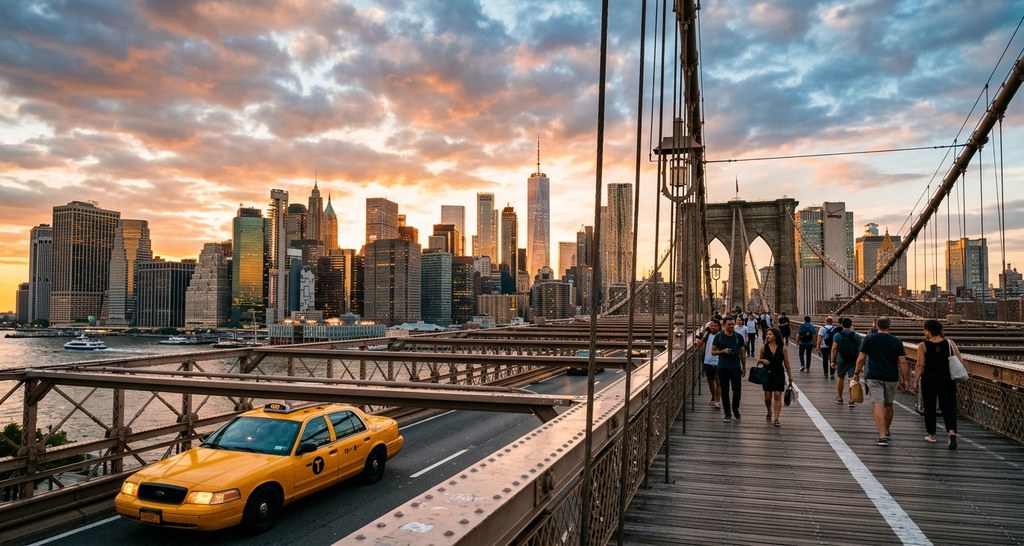
Brooklyn Bridge appears in countless films, from Saturday Night Fever’s opening credits to superhero landings in The Amazing Spider-Man. Walk across it from Manhattan to Brooklyn for skyline views featured in dozens of movies.
DUMBO’s Washington Street (between Front and Water Streets) offers the famous Manhattan Bridge framed between brick buildings shot — the spot seen in Once Upon a Time in America and countless Instagram photos.
Coney Island‘s boardwalk, Wonder Wheel, and Cyclone roller coaster appear in films from The Warriors (1979) to Requiem for a Dream (2000), representing both nostalgic Americana and urban decay depending on the decade.
On-Location Note: Visiting Hook & Ladder Company 8 in Tribeca (the legendary Ghostbusters headquarters) remains one of my favorite NYC film pilgrimages. While many famous movie facades are strictly private residential buildings where visitors have to keep their distance, the firefighters here are the real deal. They often have the bay doors open on sunny afternoons, the iconic Ghostbusters insignia is proudly painted right on the sidewalk apron outside, and seeing actual FDNY responders servicing rigs in front of a piece of 1984 cinematic history feels genuinely special.
For exact addresses, visit tips, best photo angles, and how to combine multiple locations into half-day tours, check our complete Famous NYC Filming Locations guide. Brooklyn’s filming locations deserve special attention — see our dedicated Brooklyn Filming Locations guide covering DUMBO, Williamsburg, Park Slope, and beyond.
Best Movie Theaters in NYC: Where to Watch
New York offers every kind of movie-going experience imaginable, from opulent historic palaces to cutting-edge boutique theaters serving craft cocktails to your seat.
Historic Venues
Radio City Music Hall (1260 Sixth Avenue) opened in 1932 as the world’s largest movie palace, seating nearly 6,000. While it now primarily hosts concerts and the Christmas Spectacular, special film events here remain bucket-list experiences. The Art Deco interior alone justifies a visit.
Ziegfeld Theatre closed in 2016, but several other grand theaters survive. The Beacon Theatre (2124 Broadway) occasionally screens classics alongside concerts. BAM Harvey Theater in Brooklyn hosts repertory screenings in a beautifully restored 1904 venue.
Indie & Arthouse Cinemas
Film Forum (209 West Houston Street) is NYC’s only autonomous nonprofit cinema, programming a perfect mix of revivals, foreign films, and documentaries since 1970. Three screens, no commercials, audiences who actually appreciate cinema.
Metrograph (7 Ludlow Street, Lower East Side) opened in 2016 as a love letter to old-school rep houses, with pristine 35mm projection, a curated bookshop, and a restaurant. Programming leans toward classics, cult films, and director retrospectives.
IFC Center (323 Sixth Avenue, Greenwich Village) shows indie releases, midnight movies, and themed series in a former Waverly Theatre. The Late Night Favorites series keeps cult classics like The Room and Rocky Horror alive.
Nitehawk Cinema (Williamsburg and Prospect Park locations) pioneered the dine-in theater concept in NYC, serving full meals and cocktails to your seat without the chain-restaurant vibe. Programming mixes new releases with curated repertory.
Alamo Drafthouse (Lower Manhattan and Brooklyn) brought its Austin-based model to NYC with strict no-talking/no-texting policies, creative programming, and food-and-drink service. The 14-screen Lower Manhattan location opened in 2022 near the World Trade Center.
Mainstream Multiplexes
AMC Lincoln Square (1998 Broadway) features the city’s largest IMAX screen plus Dolby Cinema. Regal Union Square (850 Broadway) sits in the heart of downtown with stadium seating and convenient subway access. Both chains offer subscription programs (AMC A-List, Regal Unlimited) that make frequent moviegoing affordable — more on that in our NYC Movie Ticket Buying Guide.
For complete theater recommendations including what to see where, membership comparisons, and insider tips, see our full Best Movie Theaters in NYC guide.
Film Festivals: NYC’s Annual Cinema Calendar
New York hosts some of the world’s most prestigious film festivals, serving as launch pads for Oscar campaigns, indie breakthroughs, and international cinema discovery.
New York Film Festival (NYFF)
Presented by Film at Lincoln Center, NYFF (typically late September through mid-October) is the city’s most prestigious festival. The 64th edition in 2026 runs September 25–October 12, showcasing 30+ Main Slate features from directors like Pedro Almodóvar, Mike Leigh, and Ryûsuke Hamaguchi. Unlike festivals focused on market sales, NYFF curates for cinephiles — expect world premieres of awards contenders and challenging international cinema. Passes and single tickets sell through FilmLinc.org, with memberships offering early access.
Tribeca Film Festival
Founded by Robert De Niro, Jane Rosenthal, and Craig Hatkoff in 2002 to revitalize Lower Manhattan post-9/11, Tribeca (typically June) celebrated its 25th anniversary in 2026 (June 3–14). The festival premieres 100+ features plus shorts, TV series, and immersive media experiences. Tribeca balances prestige premieres with accessibility — ticket packages and day passes make it more approachable than Cannes or Sundance. The festival sprawls across downtown venues, turning Tribeca into a two-week cinema party.
Other Major Festivals
DOC NYC (November) is America’s largest documentary festival, showcasing 200+ nonfiction films across every subject imaginable. New Directors/New Films (co-presented by MoMA and Film at Lincoln Center, typically March) highlights emerging international talent. Human Rights Watch Film Festival (June) focuses on social justice documentaries and narratives. New York Asian Film Festival (summer) celebrates Asian cinema across genres.
Free Outdoor Screenings
Summer brings free movies to parks citywide. Bryant Park Summer Film Festival (Monday nights, June–August) screens classics on a massive lawn behind the New York Public Library — arrive early with blankets and picnics. Rooftop Films hosts indie screenings on Brooklyn and Manhattan rooftops with skyline views. Governors Island and parks across all five boroughs offer additional free programming throughout warm months.
For festival dates, pass-buying strategies, and how to score tickets to sold-out premieres, see our complete New York Film Festivals guide. For free outdoor screening schedules and insider tips, check our Free Movies in NYC guide.
The History of NYC Movie Theaters
Understanding New York’s movie theater history means understanding the birth of American cinema exhibition itself.
The Nickelodeon Era (1900s–1910s)
Before movie palaces, there were nickelodeons — small storefront theaters charging five cents admission. New York’s first nickelodeon opened around 1904, and within years hundreds operated across the city, particularly on the Lower East Side where immigrant audiences embraced the new medium. These bare-bones venues showed short films on loop, accompanied by live piano. By the mid-1900s, New Yorkers fell in love with moving pictures, even before Hollywood existed.
Movie Palaces (1910s–1930s)
As cinema’s popularity exploded, theaters became grander. Times Square and the Theater District birthed the “movie palace” — ornate, cathedral-like venues seating thousands. The Strand Theatre (1914, Broadway and 47th Street) was arguably first, built for $1 million. The Roxy Theatre (1927, 50th Street) seated 5,920 and featured a full orchestra — the largest theater ever built at its opening. Radio City Music Hall (1932) still stands as the pinnacle of Art Deco theater design.
Marcus Loew financed spectacular theaters across all five boroughs — many Loew’s palaces featured Rococo architecture, elaborate lobbies, and organ performances before films. The Paramount Theatre in Brooklyn (1928) seated over 4,000 and doubled as a jazz venue hosting Miles Davis and Ella Fitzgerald.
Decline and Loss (1950s–1980s)
Television, suburbanization, and changing economics killed most movie palaces. The Roxy was demolished in 1960. The Paramount became Long Island University’s gym. Times Square theaters turned into porn houses or closed entirely. By the 1970s, NYC’s movie culture centered on rep houses showing classics and foreign films (The New Yorker Theatre, the Thalia) and gritty multiplexes.
Renaissance (1990s–Present)
Restoration efforts saved landmarks like Radio City. New multiplexes with stadium seating and modern amenities opened in the 1990s–2000s (AMC and Regal locations in Times Square, Union Square). Simultaneously, boutique theaters like Film Forum, IFC Center, and later Metrograph and Nitehawk created a thriving arthouse scene. Today’s NYC theater landscape balances historic preservation, multiplex convenience, and curated indie programming better than perhaps any city in America.
Theater Insider Memory: Stepping inside Brooklyn’s restored Kings Theatre in Flatbush for an anniversary screening felt like stepping directly into 1929. Modern suburban multiplexes give you automated heated recliners, but nothing matches the breathtaking acoustic resonance and collective awe of 3,000 cinephiles sitting beneath ornate French Renaissance gilded ceilings and dramatic velvet drapery. It’s a vivid reminder of when going to the movies was treated as a grand civic event.
For the complete historical narrative, lost theaters, and what survives today, see our dedicated History of NYC Movie Theaters guide.
How Movies Are Actually Filmed in NYC

Ever wonder what those white tents and equipment trucks mean? How productions get permission to shut down streets? Why crew members hand out “apology for noise” flyers in your neighborhood?
The Mayor’s Office of Media & Entertainment (MOME)
All commercial filming in NYC requires permits issued by MOME. The office exists to balance production needs with resident quality of life, issuing roughly 50,000+ film permits annually. Productions must notify residents, follow noise restrictions, and pay fees for street closures and parking reservations.
Why Directors Choose NYC
Despite high costs and logistical complexity, NYC offers what Hollywood backlots cannot: authenticity, density, and variety. Directors can shoot Wall Street, Greenwich Village, Harlem, and Coney Island in one day. The city’s 24/7 energy adds production value no set replicates. Plus, NYC offers $420 million+ in annual film tax credits, making it financially competitive with Toronto or Atlanta.
Studio Infrastructure
NYC houses major studios: Kaufman Astoria Studios (Queens), Silvercup Studios (Queens and the Bronx), and Steiner Studios (Brooklyn Navy Yard) — the largest outside Hollywood. These facilities handle interior shoots while locations provide exteriors, making NYC a full-service production hub.
What You See on the Street
White tents are “base camps” — catering, makeup, costume areas for cast and crew. Equipment trucks line blocks for days. Production assistants (“PAs”) manage pedestrian and vehicle traffic. That flashing yellow light on a pole? It signals “roll camera” to stop background noise. If you see period cars or fake snow in July, a period piece is shooting.
Most productions welcome onlookers from a distance — just follow PA instructions and never cross into the “hot set” (active filming area). Some productions allow photo-taking; others prohibit it. Always ask politely.
Behind-the-Scenes Encounter: Anyone living in New York eventually wakes up to bright orange “No Parking – Film Shoot” notices taped to street poles. I stumbled upon a major television shoot on Broome Street in SoHo on a Tuesday morning. The sheer scale was mesmerizing—five 40-foot grip trucks, catering craft services, and massive diffused lighting cranes blocking half the avenue. The production assistants politely held the crosswalk during active takes (“Quiet on the set, roll camera!”), and it took nearly two hours and fifteen takes just to capture a thirty-second walk-and-talk shot of two characters hailing a yellow cab.
For everything about permits, location scouting, what those trucks mean, and production etiquette, see our How Movies Are Filmed in NYC guide.
NYC Neighborhoods on Film
Different neighborhoods carry different cinematic identities. Directors use locations as visual shorthand to communicate class, culture, era, and mood without dialogue.
Times Square & Midtown
Times Square has two cinematic identities: the gritty 1970s version (Taxi Driver, Midnight Cowboy) defined by neon sleaze and danger, and the sanitized modern version (superhero movies, rom-coms) that’s bright, touristy, and family-friendly. The transformation from one to the other literally tracks NYC’s gentrification on film.
Greenwich Village
The Village represents bohemian creativity, LGBTQ+ culture, and artistic rebellion. Films set here (Breakfast at Tiffany’s, I Am Legend, Searching for Bobby Fischer) use brownstone stoops, Washington Square Park, and tree-lined streets to signal intelligence, nonconformity, and old-New-York charm.
Upper West Side
Woody Allen’s favorite neighborhood — intellectual, neurotic, museum-adjacent. Films here often feature characters who are writers, academics, or therapists living in pre-war apartments with high ceilings. See Manhattan, Annie Hall, You’ve Got Mail.
Upper East Side
Old money, museums, privilege. The Upper East Side often plays “establishment wealth” in contrast to scrappier downtown neighborhoods. Gossip Girl, The Devil Wears Prada, and Wall Street use this neighborhood to signal power and refinement.
Harlem
Harlem’s cinematic representation evolved from blaxploitation films of the 1970s to nuanced explorations of Black culture and gentrification (Malcolm X, Jungle Fever, If Beale Street Could Talk). The neighborhood’s brownstones, Apollo Theater, and street life carry deep cultural significance on screen.
Brooklyn Neighborhoods
Each Brooklyn neighborhood plays differently: Williamsburg represents hipster gentrification; DUMBO offers waterfront industry turned upscale; Park Slope plays family-friendly brownstone living; Coney Island evokes nostalgia and working-class grit. Directors choose Brooklyn neighborhoods as carefully as Manhattan ones to communicate specific class and cultural codes.
For deep dives into how each neighborhood’s architecture, culture, and history shape its on-screen identity, see our NYC Neighborhoods on Film guide.
Classic NYC Movie Moments & Where They Were Shot
Certain scenes are so iconic they define not just their films but the locations themselves.
The Orgasm Scene (When Harry Met Sally, 1989)
Location: Katz’s Delicatessen, 205 East Houston Street
Sally (Meg Ryan) fakes an orgasm at a deli table to prove a point to Harry (Billy Crystal). The punchline — an older woman (director Rob Reiner’s mother) ordering “I’ll have what she’s having” — became one of cinema’s most-quoted lines. The deli marks the table with a sign, and tourists still visit to recreate the moment.
“You talkin’ to me?” (Taxi Driver, 1976)
Location: Filmed in a real Hell’s Kitchen apartment (exact address not publicly confirmed)
Robert De Niro’s improvised mirror confrontation scene became shorthand for unhinged masculinity. Travis Bickle’s descent into violence is inseparable from the grimy, neon-lit 1970s New York surrounding him.
The Upside-Down Kiss (Spider-Man, 2002)
Location: Alley behind a Queens house (staged, no specific public location)
Peter Parker (Tobey Maguire) kisses Mary Jane (Kirsten Dunst) while hanging upside-down in the rain. The rain-soaked romance became one of the most-parodied superhero moments.
Holly Golightly’s Breakfast (Breakfast at Tiffany’s, 1961)
Location: Tiffany & Co., 727 Fifth Avenue at 57th Street
Audrey Hepburn in a black Givenchy dress, eating a pastry while gazing at jewels through the window at dawn. Director Blake Edwards filmed at 5am to capture empty streets — nearly disrupted by Soviet Premier Nikita Khrushchev’s surprise NYC visit the same week.
Grand Central Waltz (The Fisher King, 1991)
Location: Grand Central Terminal Main Concourse
Director Terry Gilliam shut down Grand Central’s main hall from 8pm to 5:30am to film hundreds of commuters spontaneously waltzing in Parry’s (Robin Williams) imagination. The surreal sequence required massive coordination with Metro-North and dozens of extras learning choreography.
The Avengers Assemble (The Avengers, 2012)
Location: Multiple Midtown locations, primarily around Grand Central and 42nd Street
The climactic battle where the superhero team fights off an alien invasion turned Midtown Manhattan into a war zone. The circular shot of the team standing back-to-back became one of Marvel’s most iconic images.
Scene Recreation: Recreating the opening scene of Breakfast at Tiffany’s outside the Fifth Avenue flagship store requires just one trick: timing. If you arrive at 6:45 AM on a Sunday morning with a warm croissant and coffee in a brown paper bag, Fifth Avenue is utterly deserted. For about fifteen magical minutes before traffic and shopping crowds descend, the quiet reflection in Tiffany’s polished display windows feels completely frozen in 1961.
For scene-by-scene breakdowns, behind-the-scenes stories, and exact filming spots with visit tips, see our Classic New York Movie Moments guide.
Saving Money: Free Movies & Ticket Discounts
NYC movie tickets can run $18-25+, but plenty of ways exist to watch films affordably or free.
Free Outdoor Screenings
Summer brings dozens of free outdoor movie series across all five boroughs. Bryant Park, Central Park, Brooklyn Bridge Park, and neighborhood parks screen classics and recent favorites under the stars. Arrive early with blankets and snacks — the best spots fill fast. Most series run June through August on specific weekday nights.
Discount Days & Memberships
Many theaters offer discount days: Kew Gardens Cinemas has $9 Tuesdays and Thursdays; Regal offers $5-7 Tuesday tickets for Crown Club members; some Cinemark locations have Discount Tuesdays at 50% off. AMC Stubs A-List ($19.95–$24.95/month) offers up to 3 movies per week including IMAX and Dolby with no surcharges. Regal Unlimited ($21.49–$26.49/month) offers truly unlimited tickets but charges surcharges for premium formats.
IDNYC Cardholders
Free NYC ID cards (IDNYC) come with entertainment discounts including reduced movie tickets at participating theaters and cultural institutions. Check NYC.gov for current partners.
Student & Senior Discounts
Most theaters offer student discounts with valid ID, and many offer senior pricing (typically 60+ or 65+). Art house cinemas like Film Forum and Metrograph often have lower base prices than multiplexes.
For complete free screening schedules, membership comparisons, and money-saving strategies, see our Free Movies in NYC and NYC Movie Ticket Buying Guide.
Common Mistakes to Avoid
- Visiting filming locations without research: Not all locations are publicly accessible year-round. Some (like apartment building exteriors) are private residences — photograph respectfully from the sidewalk without trespassing.
- Assuming all historic theaters still show movies: Many famous movie palaces now host concerts, Broadway shows, or closed entirely. Check current programming before planning a visit.
- Missing festival advance tickets: NYFF and Tribeca sell out popular screenings quickly. Memberships and passes offer early access — waiting until single tickets go on sale risks disappointment.
- Ignoring outer boroughs: Brooklyn, Queens, and the Bronx offer rich filming locations and quality theaters often less crowded and cheaper than Manhattan options. Don’t skip them.
- Overpaying for tickets: With memberships, discount days, and free outdoor screenings available, paying full price rarely makes sense if you see movies regularly.
- Disrupting active film shoots: It’s exciting to stumble onto a production, but crossing into the set, making noise during takes, or ignoring PA instructions can delay filming and annoy crews. Watch respectfully from designated areas.
- Visiting Central Park filming locations in peak summer: Iconic spots like Bow Bridge and Bethesda Fountain are mobbed June–August. Visit early morning or shoulder seasons (April-May, September-October) for better photos and fewer crowds.
Your NYC Movie Checklist
To fully experience New York through cinema, check off these essential experiences:
- Watch a classic NYC film before visiting (start with Manhattan, When Harry Met Sally, or Do the Right Thing)
- Visit at least one famous filming location in person (Central Park, Katz’s Deli, or the Ghostbusters firehouse)
- See a movie at a historic or boutique theater (Film Forum, Metrograph, Radio City, or BAM)
- Attend a free outdoor summer screening in Bryant Park or Brooklyn Bridge Park
- Walk across the Brooklyn Bridge (featured in Saturday Night Fever, Annie Hall, and dozens more)
- Take a self-guided filming location walking tour through one neighborhood (Greenwich Village and Central Park offer the highest density of iconic spots)
- Catch a film at a festival (NYFF, Tribeca, or a neighborhood festival)
- Stumble onto an active film shoot (they happen daily — look for white tents, equipment trucks, and yellow flashing lights)
- Visit Grand Central Terminal and imagine the Fisher King waltz or Avengers battle
- Explore Brooklyn filming locations (DUMBO’s Washington Street Manhattan Bridge view, Coney Island boardwalk)
Cinephile Progress: Having ticked off seven out of the ten experiences on this bucket list—from summer sunset screenings at Brooklyn Bridge Park to catching rare 35mm archival prints at Film Forum—the next must-do on my calendar is attending a 70mm screening at the Museum of the Moving Image in Astoria and catching an outdoor screening during the Tribeca Film Festival.
Frequently Asked Questions
What is the most filmed location in NYC?
Central Park is the single most-filmed location in New York City, appearing in over 300 films. Its 843 acres offer diverse landscapes — wooded paths, open lawns, romantic bridges, fountains, and skyline views — allowing directors to shoot everything from rom-coms to superhero battles to period dramas within one park. Specific hotspots include Bow Bridge, Bethesda Fountain, the Boathouse, and the Mall.
Can you visit the Friends apartment building?
The exterior shots of the Friends apartment building were filmed at 90 Bedford Street (corner of Grove Street) in Greenwich Village. It’s a real residential building, so you can photograph the facade from the sidewalk but cannot enter. The actual interior sets were filmed on a soundstage in California. Many tourists visit for photos — be respectful of residents.
Where is the Ghostbusters firehouse located?
The Ghostbusters headquarters is Hook & Ladder Company 8, an active FDNY firehouse at 14 North Moore Street in Tribeca (at the intersection with Varick Street). Only the exterior appears in the films; interiors were sets. Tourists can photograph the iconic red doors from the street but should not disrupt firefighters’ work. The building dates to 1903 and features Beaux-Arts architecture.
What’s the best way to see NYC filming locations?
Self-guided walking tours work best, focusing on one neighborhood at a time. Manhattan’s Central Park and Greenwich Village offer the highest density of iconic locations within walking distance. Download our complete filming locations guide with addresses and maps, or join a commercial movie tour for guided context. Visit early morning or off-season to avoid crowds at popular spots like Katz’s Deli or Bow Bridge.
Which NYC film festival is most prestigious?
The New York Film Festival (NYFF), presented by Film at Lincoln Center each fall, is widely considered NYC’s most prestigious festival. Unlike market-driven festivals, NYFF curates for artistic merit, premiering awards-season contenders and challenging international cinema. It’s not as industry-focused as Sundance or Cannes but carries significant cultural weight. Tribeca Film Festival is larger and more accessible, while DOC NYC dominates documentary programming.
Are movie tickets cheaper in NYC on certain days?
Yes. Many theaters offer discount days, typically Tuesdays. Regal Crown Club members get $5-7 Tuesday tickets; some Cinemark locations offer 50% off Tuesdays; Kew Gardens Cinemas offers $9 tickets Tuesdays and Thursdays. Matinee showings (typically before 4pm or 5pm) cost less at most theaters. Subscription services like AMC Stubs A-List and Regal Unlimited make frequent moviegoing significantly cheaper than buying individual tickets.
Where can I watch free movies in NYC?
Summer brings dozens of free outdoor screenings across all five boroughs. Bryant Park Summer Film Festival (Monday nights, June–August) is the most famous, screening classics on a massive lawn behind the New York Public Library. Rooftop Films shows indies on Brooklyn and Manhattan rooftops. Parks throughout the city host free screenings — check NYC Parks’ website for schedules. Many museums also offer free or pay-what-you-wish film series.
Can you still visit locations from movies filmed decades ago?
Many yes, some no. Tiffany & Co., Grand Central Terminal, Central Park, the Brooklyn Bridge, and the Ghostbusters firehouse all look nearly identical to their film appearances. However, some locations have changed significantly or vanished entirely: the original Penn Station (demolished 1963), pre-gentrification Times Square, and the World Trade Center Twin Towers. When visiting old filming locations, expect modern changes — storefronts, signage, and street traffic differ from period films.
Why do so many movies film in NYC instead of on Hollywood sets?
Authenticity and variety. NYC offers real urban density, diverse architecture, and 24/7 energy no backlot can replicate. Directors can shoot Wall Street, Harlem, Greenwich Village, and Coney Island in one day, each with distinct visual identity. NYC also provides significant tax credits (up to 30% of production costs), making it financially competitive with cheaper filming cities. Major studios in Queens and Brooklyn offer sound stages for interiors while real streets provide exteriors.
What’s the difference between AMC A-List and Regal Unlimited?
AMC Stubs A-List ($19.95–$24.95/month depending on location) allows up to 3 movies per week with all premium formats (IMAX, Dolby, 3D) included at no extra charge. Regal Unlimited ($21.49–$26.49/month by ZIP code) offers truly unlimited movies but charges surcharges for premium formats. A-List caps weekly tickets but includes premium formats; Regal Unlimited offers unlimited standard tickets but upcharges for IMAX/RPX. Choose based on whether you value volume or premium formats.
How can I find out what’s filming in NYC right now?
The Mayor’s Office of Media & Entertainment posts some filming notices, but most productions aren’t publicly announced until after filming. Follow local NYC film news sites and social media accounts that track sightings. If you stumble onto a shoot (white tents, equipment trucks, crews), you can politely ask PAs what’s filming — some will tell you, others won’t. Many productions become obvious once you spot recognizable actors or period vehicles.
Are there guided movie location tours in NYC?
Yes, several companies offer guided tours: On Location Tours runs bus and walking tours focused on specific shows/films (Sex and the City, Gossip Girl, Superhero sites). Free Tours by Foot offers a pay-what-you-wish Central Park Movie Tour. Private tour companies can customize routes. Self-guided tours work well too — download our location guides with addresses and use Google Maps to plan efficient routes.
Ready to Experience NYC Through Cinema?
New York City’s relationship with movies runs deeper than any other city. It’s not just a backdrop — it’s a character, a muse, and a living film set where every block holds cinematic history. Whether you’re watching classics at Film Forum, recreating famous scenes at Katz’s Deli, catching free summer movies in Bryant Park, or stumbling onto an active shoot in Tribeca, NYC offers film lovers experiences no other city can match.
Start with one neighborhood, one film, one theater. Let the city reveal itself through the lens of cinema, the way directors from Charlie Chaplin to Greta Gerwig have done for over a century. The cameras are always rolling in New York — you’re already in the scene.
The Definitive NYC Movie Feeling: My defining New York movie moment happened walking across the Brooklyn Bridge boardwalk at twilight during a gentle autumn mist. Yellow cabs were streaking below, harbor ferries were cutting through the East River, and the Lower Manhattan financial towers were glowing against the overcast sky like a frame straight out of Taxi Driver or Spider-Man. That is the magic of this city: you never feel like a passive observer; you feel like you are walking inside the frame.