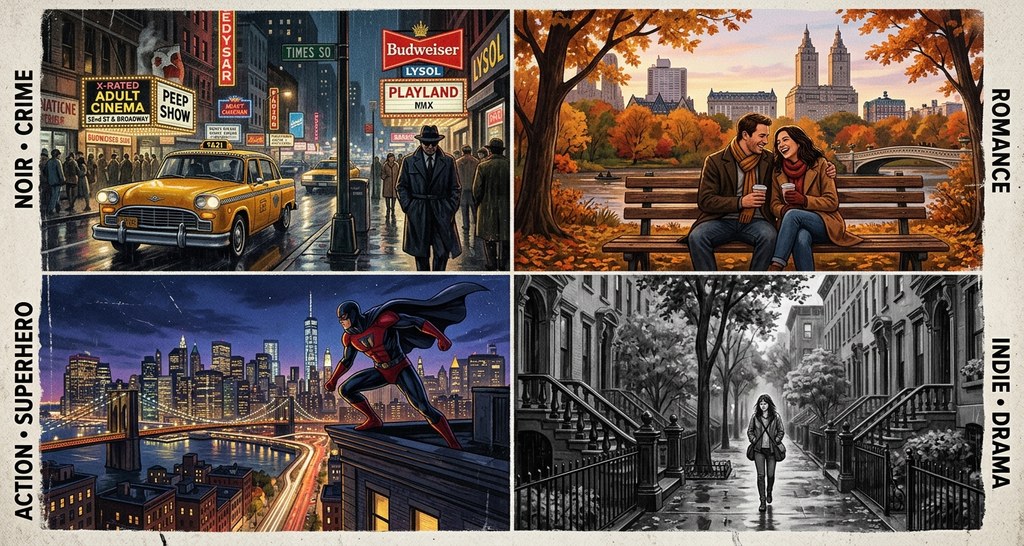
The best movies set in New York City span every genre and era: The Godfather (1972) and Taxi Driver (1976) for gritty crime dramas; When Harry Met Sally (1989) and Manhattan (1979) for romance; Do the Right Thing (1989) and Mean Streets (1973) for neighborhood stories; The Avengers (2012) and Spider-Man (2002) for superhero action; and Frances Ha (2012) and Inside Llewyn Davis (2013) for indie character studies. NYC isn’t just a backdrop in these films — it shapes character, drives plot, and defines mood. This genre-by-genre guide helps you discover essential NYC films whether you want gritty 1970s realism, romantic comedy magic, or modern superhero spectacle.
For behind-the-scenes stories on iconic scenes, check out our guide to classic New York movie moments.
For the complete overview of cinema, theaters, and filming across the five boroughs, explore our comprehensive New York Movies ultimate guide.
Crime & Noir: New York at Its Darkest
New York’s criminal underworld has provided endless material for filmmakers exploring power, corruption, and moral ambiguity.
Many of these legendary crime scenes were shot on location—explore our guide to famous NYC filming locations you can visit to see them in person.
The Godfather (1972)
Francis Ford Coppola’s masterpiece uses Little Italy and the Bronx to tell the Corleone family saga. The film’s New York scenes — from Genco’s restaurant to the Bronx wedding — ground the story in specific Italian-American neighborhoods where loyalty and tradition clash with American capitalism. Marlon Brando’s Don Vito Corleone embodies old-world values struggling against modernity.
Taxi Driver (1976)
Martin Scorsese captures 1970s Times Square at its grittiest: neon-lit porn theaters, street prostitution, urban decay. Robert De Niro’s Travis Bickle drives through rain-slicked streets observing “the scum” while descending into vigilante madness. The film’s jaundiced view of NYC — dangerous, lonely, morally bankrupt — shocked audiences but captured a real moment when the city teetered on bankruptcy and chaos.
Dog Day Afternoon (1975)
Sidney Lumet’s true-story bank robbery goes catastrophically wrong in Brooklyn, turning into a media circus and hostage negotiation. Al Pacino’s desperate Sonny electrifies the crowd outside, shouting “Attica! Attica!” The film captures NYC’s working-class outer boroughs and the circus-like atmosphere when crime becomes spectacle.
The French Connection (1971)
The car chase beneath the elevated train in Brooklyn remains one of cinema’s greatest action sequences. Gene Hackman’s “Popeye” Doyle chases a drug smuggler through real NYC streets with documentary-like grit. The film’s cold, unglamorous vision of police work in winter New York set the template for decades of crime dramas.
Serpico (1973)
Al Pacino plays real-life NYPD whistleblower Frank Serpico, exposing systemic corruption. Shot on location across Brooklyn, Manhattan, and the Bronx, the film shows precinct houses, tenements, and street corners where dirty cops operated openly. Lumet’s New York is institutional — the buildings and neighborhoods reflect a system resistant to change.
Local Reflection on NYC Crime Cinema: Watching Taxi Driver and The French Connection before moving to New York gave me a dark, mythical impression of the city. But taking the D train through Bensonhurst and walking past Roosevelt Island’s tramway makes you realize how grounded those films actually were. William Friedkin didn’t use soundstages; he literally chased an elevated subway train underneath the tracks on 86th Street with real oncoming traffic. When you stand on that platform today with the rumble of the express train shaking the steel beams, that nervous, raw energy feels identical to 1971.
Romance & Comedy: Falling in Love in Manhattan
New York’s romantic identity on film centers on chance meetings, long walks, and the belief that the city itself facilitates connection.
When Harry Met Sally (1989)
Rob Reiner’s rom-com follows Billy Crystal and Meg Ryan through a decade of friendship and almost-romance, using Katz’s Deli, Central Park’s Boat House, and countless street corners as their stages. The film’s montages of elderly couples telling their “how we met” stories cement NYC as the ultimate romantic backdrop. Every location — Washington Square Park, the Metropolitan Museum, Broadway bookstores — suggests a city built for serendipity.
Manhattan (1979)
Woody Allen’s black-and-white valentine to NYC opens with Gershwin’s “Rhapsody in Blue” playing over iconic shots: the 59th Street Bridge, Central Park, the Guggenheim, fireworks over the skyline. Isaac (Allen) and Tracy (Mariel Hemingway) sit on a bench in Sutton Place watching the Queensboro Bridge at sunrise. Allen’s Manhattan is intellectual, neurotic, cultured — museums, concerts, therapy sessions — a fantasy version real New Yorkers aspired to inhabit.
Breakfast at Tiffany’s (1961)
Audrey Hepburn’s Holly Golightly eats breakfast while gazing through Tiffany’s window at dawn, defining aspirational Manhattan glamour. The film’s Greenwich Village apartment, Fifth Avenue walks, and Tiffany’s facade made upscale New York synonymous with sophistication and possibility for audiences worldwide.
Annie Hall (1977)
Another Woody Allen classic, this one contrasts neurotic Manhattan intellectualism with laid-back Los Angeles superficiality. Alvy Singer (Allen) and Annie Hall (Diane Keaton) navigate relationships against Upper West Side apartments, Brooklyn childhood homes, and Manhattan cocktail parties. The film’s fragmented structure and breaking of the fourth wall feel as restless and self-aware as New York itself.
You’ve Got Mail (1998)
Nora Ephron updates the rom-com formula for the internet age, pairing Meg Ryan’s independent Upper West Side bookstore owner against Tom Hanks’ corporate chain competitor. The film’s warm autumnal vision of Manhattan — Cafe Lalo, Riverside Park, brownstone stoops — offers comfort food cinema where neighborhood identity matters deeply.
Romance in Real Life: If you want to experience the romantic magic of Nora Ephron’s New York, skip the overcrowded tourist traps and take a quiet stroll through Central Park’s Conservatory Water on an overcast November weekday. Walking past the Loeb Boathouse with two hot cider cups while dried leaves swirl across the pavement captures that effortless, bittersweet charm you see in When Harry Met Sally and You’ve Got Mail far better than any choreographed tour.
Neighborhood Stories: The Real New York
The best NYC neighborhood films understand that each area has its own culture, rules, and rhythms — and directors who grew up there bring insider authenticity.
To see how different boroughs define cinematic tone, explore our analysis of NYC neighborhoods on film.
Do the Right Thing (1989)
Spike Lee’s masterpiece unfolds on one sweltering Brooklyn block in Bedford-Stuyvesant, where racial tensions explode on the hottest day of summer. Lee uses Stuyvesant Avenue between Lexington and Quincy as his stage, building a multi-ethnic ensemble (Black residents, Italian pizzeria owners, Korean grocers, Puerto Rican neighbors) whose coexistence collapses into violence. The film captures block-level community dynamics — who belongs, who’s gentrifying, whose culture dominates public space — with specificity only an insider could achieve.
Mean Streets (1973)
Martin Scorsese’s breakthrough explores Little Italy’s small-time criminals struggling between Catholic guilt and street loyalty. Charlie (Harvey Keitel) tries to manage his reckless friend Johnny Boy (Robert De Niro) while navigating mob expectations and religious doubt. The film’s claustrophobic framing and handheld camera work make Little Italy feel simultaneously vibrant and suffocating — a neighborhood where everyone knows everyone and escape feels impossible.
Saturday Night Fever (1977)
Bay Ridge, Brooklyn becomes the epicenter of disco culture as Tony Manero (John Travolta) lives for Saturday nights at 2001 Odyssey nightclub. The film captures working-class outer-borough life — dead-end jobs, bridge-and-tunnel commutes, the disco floor as the only place where style and skill matter more than class. The Verrazano-Narrows Bridge opening shot establishes Brooklyn as separate from Manhattan — geographically close but culturally distant.
25th Hour (2002)
Spike Lee’s post-9/11 New York follows a drug dealer (Edward Norton) on his last day before prison, traveling from Manhattan clubs to Brooklyn homes to Queens neighborhoods. The film’s famous mirror monologue (“Fuck you” rant targeting every NYC type) expresses the love-hate relationship New Yorkers have with their city. Lee captures a wounded, uncertain New York still processing trauma.
Summer of Sam (1999)
Another Spike Lee film, this one set in 1977 Bronx during the Son of Sam serial killings and the Yankees’ championship season. The neighborhood’s paranoia, the sense of being under siege, and the violence directed at perceived outsiders shows how external threats can fracture communities.
Superhero & Sci-Fi: NYC Under Attack
New York’s density and iconic skyline make it the perfect city to destroy, defend, or save — repeatedly.
The Avengers (2012)
Joss Whedon’s superhero ensemble fights off an alien invasion in Midtown Manhattan, with Grand Central Terminal, 42nd Street, and Stark Tower as ground zero. The climactic battle turns familiar locations into war zones, but the film’s coda — showing New Yorkers calmly cleaning up, honoring heroes, and returning to normal — reflects the city’s resilient identity post-9/11.
Spider-Man (2002)
Sam Raimi’s superhero origin story roots Peter Parker (Tobey Maguire) in Queens (Forest Hills) while swinging through Manhattan’s skyscrapers. The film’s Green Goblin attacks the Queensboro Bridge and attacks Times Square, but its heart lies in Peter’s working-class outer-borough roots — the contrast between modest Queens and gleaming Manhattan underlies his everyman appeal.
Ghostbusters (1984)
Ivan Reitman’s comedy uses NYC landmarks as supernatural hotspots: the main branch of the New York Public Library, a Central Park West apartment building, and the Tribeca firehouse that becomes headquarters. The film treats paranormal activity as just another NYC pest-control problem, blending deadpan humor with spectacular special effects.
Men in Black (1997)
Barry Sonnenfeld’s sci-fi comedy reimagines New York as the primary point of entry for alien immigrants — a clever metaphor for the city’s real immigrant history. The film uses distinctive locations (the Queens-Midtown Tunnel, Battery Park, the Guggenheim) while revealing a secret underground world operating invisibly alongside everyday New York.
Escape from New York (1981)
John Carpenter’s dystopian thriller imagines Manhattan as a maximum-security prison island where the President’s plane crashes. Though shot cheaply in St. Louis, the film’s premise taps into 1970s-80s fears that New York had become ungovernable. The idea of walling off Manhattan and letting it self-destruct reflected genuine anxieties about urban decay.
Indie & Art House: Personal New York
Independent films often capture NYC’s textures and rhythms more intimately than big-budget productions, focusing on character over spectacle.
Frances Ha (2012)
Noah Baumbach’s black-and-white portrait of a struggling dancer (Greta Gerwig) captures millennial New York’s precariousness — apartment-hopping, unpaid internships, dreams deferred. Frances moves from Chinatown to Brooklyn to Washington Heights, each displacement reflecting economic realities young creatives face. The film’s loose, episodic structure and awkward energy feel authentically lived-in.
Inside Llewyn Davis (2013)
The Coen Brothers recreate Greenwich Village’s 1961 folk scene with meticulous period detail. Llewyn (Oscar Isaac) crashes on friends’ couches, plays the Gaslight Cafe, and navigates a music industry on the verge of change (Bob Dylan’s arrival is imminent). The film’s cold, grey cinematography and circular structure capture artistic struggle and the sense of being left behind by history.
Kids (1995)
Larry Clark’s controversial debut offers a raw, unflinching look at mid-1990s downtown youth culture — skateboarding, drug use, casual sex, HIV/AIDS anxiety. Shot in Washington Square Park, East Village apartments, and downtown streets, the film shocked audiences with its documentary-like depiction of unsupervised teenagers. Whether exploitation or authenticity remains debated.
The Squid and the Whale (2005)
Noah Baumbach’s autobiographical film about his parents’ divorce captures 1980s Park Slope, Brooklyn intellectualism. The bohemian brownstone family dissects literature and relationships with equal neurotic intensity, making artistic achievement both aspiration and burden.
Parting Glances (1986)
Bill Sherwood’s indie drama explores gay life in 1980s Manhattan as the AIDS crisis begins. The film’s matter-of-fact depiction of gay relationships and the specter of illness marked a turning point in queer cinema. Greenwich Village locations ground the story in a specific community facing devastating loss.
The Relatable Indie Experience: No film captured my early twenties in the city quite like Greta Gerwig and Noah Baumbach’s Frances Ha. That frantic, awkward feeling of apartment-hunting in Chinatown, constantly checking your bank account before buying a bodega iced coffee, and dancing along the Chinatown crosswalks while wondering if your ambitions make any sense—it’s an uncannily accurate portrayal of what finding your footing in modern New York actually feels like.
Musicals: NYC in Song
Few genres celebrate New York’s energy and possibility like musicals, where the city becomes a stage for dreams and performance.
West Side Story (1961/2021)
Both Robert Wise’s 1961 original and Steven Spielberg’s 2021 remake adapt Romeo and Juliet to 1950s Upper West Side gang warfare. The original used stylized sets and Lincoln Center-area locations (before urban renewal); Spielberg’s version embraces gritty realism, filming in actual tenement blocks slated for demolition. Both versions explore how urban renewal, ethnic tensions, and class conflict shape neighborhood identity.
On the Town (1949)
Gene Kelly, Frank Sinatra, and Jules Munshin play sailors on 24-hour shore leave exploring New York — Brooklyn Navy Yard, Rockefeller Center, Central Park, the Empire State Building. The film’s joyful musical numbers celebrate post-war optimism and NYC as the ultimate destination for young people seeking adventure.
Guys and Dolls (1955)
Based on Damon Runyon’s Broadway characters, this musical captures Times Square’s gamblers, showgirls, and missionaries. Though mostly filmed on Hollywood sets, the story’s colorful street characters and romanticized underworld feel quintessentially New York — a mythic version tourists wished was real.
Rent (2005)
The film adaptation of Jonathan Larson’s rock musical chronicles bohemian artists in 1990s East Village during the AIDS crisis. The Alphabet City locations capture a neighborhood on the brink of gentrification, where artists could still afford rent and community mattered more than career.
Period Pieces: New York Through Time
Films set in NYC’s past allow audiences to see the city as it was — or as we imagine it was.
Gangs of New York (2002)
Martin Scorsese’s epic recreates 1860s Five Points (Lower Manhattan’s notorious slum) through elaborate sets built in Rome. The film explores immigrant gang warfare, political corruption, and the Draft Riots — a violent, chaotic New York where ethnic identity determined survival. Though historically loose, the film captures the violence and tribalism underlying NYC’s melting-pot mythology.
The Age of Innocence (1993)
Another Scorsese film, this one adapting Edith Wharton’s novel about 1870s high society. The film’s Upper East Side mansions, opera houses, and formal dinners depict Gilded Age New York where social codes and reputation constrained individual desire. Everything polished, restrained, suffocating.
Once Upon a Time in America (1984)
Sergio Leone’s epic spans 50 years in the lives of Jewish gangsters from Lower East Side childhood to Prohibition-era power. The film’s dreamlike structure and nostalgic tone make it as much about memory and loss as crime. Manhattan Bridge views from Brooklyn and Lower East Side tenements anchor the story in specific immigrant geography.
Malcolm X (1992)
Spike Lee’s biopic follows Malcolm Little from 1940s Harlem hustler to Nation of Islam leader to international activist. The Harlem sequences capture the neighborhood’s jazz clubs, street corners, and Apollo Theater during its cultural renaissance, contrasting vibrant Black culture with systemic oppression.
How to Choose Your Next NYC Movie
With thousands of films to choose from, here’s how to narrow it down:
- By mood: Want gritty realism? Watch Taxi Driver or Mean Streets. Need feel-good romance? When Harry Met Sally or Breakfast at Tiffany’s. Craving action spectacle? The Avengers or The French Connection.
- By neighborhood: Curious about Brooklyn? Do the Right Thing, Saturday Night Fever, The Squid and the Whale. Manhattan-focused? Manhattan, Annie Hall, Frances Ha. Harlem? Malcolm X, Summer of Sam.
- By era: Want to see 1970s New York? Taxi Driver, Dog Day Afternoon, Annie Hall. 1990s? Kids, Summer of Sam. Contemporary? 25th Hour, Frances Ha, The Avengers.
- By genre: Crime: The Godfather, Serpico, The French Connection. Romance: When Harry Met Sally, Manhattan. Superhero: Spider-Man, The Avengers. Indie: Frances Ha, Inside Llewyn Davis.
- Before visiting locations: Watch films featuring places you’ll visit. Planning Central Park? When Harry Met Sally. Going to Brooklyn Bridge? Saturday Night Fever. Visiting Times Square? Taxi Driver (historical) or Elf (contemporary).
How I Choose What to Watch: When friends ask how to pick an NYC movie for movie night, I always recommend choosing by neighborhood and seasonal mood rather than genre. On sweltering August weekends, nothing beats Spike Lee’s scorching Bedford-Stuyvesant in Do the Right Thing. On crisp autumn evenings, it has to be Greenwich Village in Inside Llewyn Davis or Woody Allen’s black-and-white Upper East Side in Manhattan.
Common Mistakes When Exploring NYC Movies
- Expecting locations to look exactly like films from decades ago: Times Square in Taxi Driver is unrecognizable today. NYC constantly changes — some locations evolve, others vanish entirely.
- Ignoring outer borough films: Manhattan-centric films dominate lists, but Brooklyn, Queens, and the Bronx have equally rich cinematic identities. Don’t skip Do the Right Thing, Saturday Night Fever, or Spider-Man’s Queens.
- Watching only one genre: NYC’s cinematic range spans musicals, crime dramas, rom-coms, superhero battles, indie character studies. Exploring multiple genres reveals the city’s versatility.
- Skipping older films due to age: Many of the best NYC films date from the 1970s-80s. Don’t let black-and-white cinematography or older styles deter you — these films capture NYC authentically before gentrification homogenized neighborhoods.
- Forgetting context: Films reflect their era’s anxieties and aspirations. Taxi Driver’s grim NYC reflects 1970s near-bankruptcy; The Avengers’ resilient city references post-9/11 recovery. Understanding context deepens appreciation.
Your NYC Movie Watchlist
If you’re new to NYC cinema, start with these ten essential films representing different genres, eras, and neighborhoods:
- When Harry Met Sally (1989) — romantic comedy, Manhattan
- Do the Right Thing (1989) — social drama, Brooklyn
- Taxi Driver (1976) — crime/psychological thriller, Manhattan
- The Godfather (1972) — crime epic, Little Italy/Bronx
- Manhattan (1979) — romantic comedy/drama, Manhattan
- Spider-Man (2002) — superhero, Queens/Manhattan
- Frances Ha (2012) — indie dramedy, multiple boroughs
- Saturday Night Fever (1977) — musical drama, Brooklyn
- The Avengers (2012) — superhero action, Midtown Manhattan
- Inside Llewyn Davis (2013) — period piece, Greenwich Village
Once you’ve watched these, explore deeper into specific directors (Scorsese, Spike Lee, Woody Allen, Noah Baumbach), eras (1970s grit, 1990s indie boom), or neighborhoods that intrigue you.
Frequently Asked Questions
What is considered the best movie set in New York City?
There’s no single answer — it depends on what “best” means. Critically, The Godfather and Taxi Driver top most lists. romantic NYC, When Harry Met Sally and Manhattan dominate. neighborhood authenticity, Do the Right Thing and Mean Streets. capturing NYC’s essence across genres, these five consistently rank highest.
Which NYC neighborhood appears in the most films?
Manhattan, particularly Midtown (Times Square, Grand Central) and Central Park, appears most frequently. Within Manhattan, the Upper West Side, Greenwich Village, and SoHo have strong cinematic identities. Brooklyn follows, especially Williamsburg, DUMBO, and Park Slope. Queens appears less often but memorably (Spider-Man, Goodfellas).
Are Woody Allen’s NYC films accurate?
Woody Allen’s films capture a specific NYC — intellectual, neurotic, Upper West Side, culturally engaged. This NYC exists but represents a narrow slice of the city’s diversity. His films romanticize Manhattan while largely ignoring outer boroughs, working-class life, and non-white communities. They’re aspirational fantasies more than documentary realism.
Why are so many movies set in 1970s New York?
The 1970s marked NYC’s nadir — near-bankruptcy, high crime, urban decay, white flight. This crisis paradoxically made the city cinematically compelling: dangerous, gritty, morally ambiguous. Films like Taxi Driver, Dog Day Afternoon, and The French Connection captured real urban anxiety. The era’s aesthetic — neon, grime, danger — remains visually striking and emotionally resonant.
What’s the difference between movies “set in” vs “filmed in” NYC?
Movies “set in” NYC take place there narratively but may be filmed elsewhere (studio sets, other cities standing in for NYC). Movies “filmed in” NYC shot on actual New York locations. The best combine both — authentically capturing NYC’s look and feel because directors actually worked there. Some films set in NYC (like Gangs of New York) filmed entirely elsewhere using elaborate sets.
Should I watch NYC movies before visiting?
Yes — films provide context for neighborhoods, landmarks, and the city’s cultural identity. Watching When Harry Met Sally before visiting Central Park or Breakfast at Tiffany’s before Fifth Avenue enriches the experience. You’ll recognize locations and understand how filmmakers use specific spots to tell stories. Just remember: films compress and romanticize reality.
Pre-Trip Film Preparation: Binge-watching NYC cinema before arriving completely transforms your travel experience. Instead of seeing generic brick buildings and busy streets, you see Peter Parker’s apartment in Queens, the deli where Meg Ryan made comedy history, and the Lower East Side tenement corridors from The Godfather Part II. Films turn the entire city into an open-air museum where every subway exit feels like stepping onto a movie set.