
Quick Answer: Rockefeller Tree History and Facts
The Rockefeller Center Christmas Tree tradition began in 1931 when construction workers building Rockefeller Center pooled their money to buy a modest 20-foot balsam fir, decorating it with handmade garlands on Christmas Eve. The first official lighting ceremony took place in 1933, and the tradition has continued for over 90 years. Today’s trees are typically 75-85 feet tall, 45-50 feet wide, and weigh 10-14 tons—Norway spruces donated by families from the Northeastern U.S. The tree is decorated with more than 50,000 LED lights strung along 5 miles of wire and topped with a 900-pound Swarovski crystal star containing 3 million crystals. After the season, the tree is donated to Habitat for Humanity and milled into lumber for affordable housing—a sustainability tradition since 2007.
Discover the origin story of NYC’s favorite holiday tradition, part of our Rockefeller Center Christmas Tree Lighting hub.
The First Tree: 1931 and the Great Depression
The Rockefeller Christmas Tree wasn’t born from corporate marketing or grand civic planning—it emerged from a humble gesture of hope during one of America’s darkest economic periods.
December 1931: Construction Workers’ Christmas
In December 1931, Rockefeller Center was a massive construction site employing thousands of workers amid the Great Depression. Jobs were scarce, money was tight, and the future felt uncertain. On Christmas Eve, a group of construction workers pooled their modest wages to purchase a 20-foot balsam fir. They set it up on the muddy construction site and decorated it with handmade paper garlands and strings of cranberries crafted by their families at home.
It wasn’t a publicity stunt or a planned tradition—it was a simple act of solidarity and celebration. The workers gathered around the tree, shared what little they had, and found a moment of normalcy and joy in the midst of economic hardship. The tree represented resilience, community, and the belief that better days were ahead.
That unassuming 20-foot fir, standing in the mud of a construction site, would become the foundation of a tradition watched by hundreds of millions worldwide nearly a century later.
Why Rockefeller Center?
Rockefeller Center, developed by John D. Rockefeller Jr., was conceived in the late 1920s as a massive commercial and entertainment complex in Midtown Manhattan. Construction began in 1930, right as the Depression hit, and the project became a symbol of American ambition and determination—a refusal to let economic collapse halt progress.
The decision to build during the Depression was risky, but Rockefeller believed the project would create jobs and revitalize Midtown. At its peak, Rockefeller Center employed over 40,000 construction workers, many of whom were desperate for steady income. The Christmas tree they erected in 1931 reflected their gratitude for employment and their hope for recovery.
Local Tip: Plan your visit during off-peak morning hours (6:00–8:00 AM) or after 10:00 PM for the most serene tree viewing experience.
The First Official Lighting: 1933
Two years after the workers’ impromptu tree, Rockefeller Center formalized the tradition with the first official Christmas tree lighting ceremony on December 24, 1933.
The 1933 Ceremony
The tree stood in front of the newly completed RCA Building (now known as 30 Rockefeller Plaza or “30 Rock”), which had opened just eight months earlier. Unlike the 1931 tree, the 1933 version was taller, professionally decorated, and lit with electric lights—a significant upgrade from handmade cranberry garlands.
The ceremony itself was modest by today’s standards—no live television broadcast (TV was still experimental in 1933), no celebrity performers, and no massive crowds cordoned off by police barricades. It was a local event for New Yorkers, marking the official opening of Rockefeller Center’s commercial spaces and signaling that the complex was open for business despite the ongoing Depression.
The 1933 ceremony established key elements that persist today: the tree positioned prominently in the plaza, electric lighting as the centerpiece, and the symbolism of the tree as a beacon of hope and renewal during challenging times.
The Ice Skating Rink (1936)
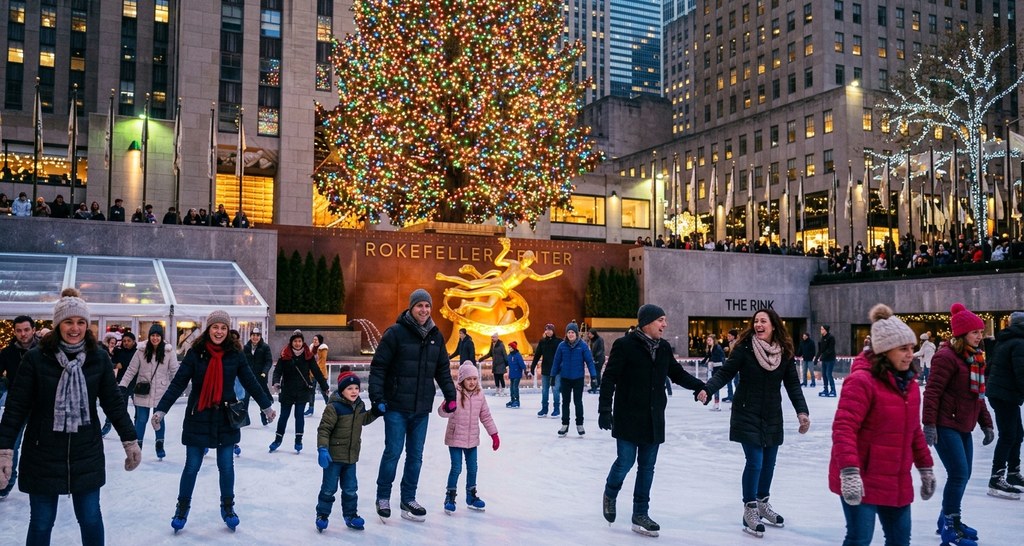
Three years later, in 1936, Rockefeller Center opened the outdoor ice skating rink directly beneath where the Christmas tree would stand. The rink, initially intended as a temporary attraction, became so popular that it was made permanent. The combination of the glowing tree towering above skaters gliding on ice created the iconic image now synonymous with Rockefeller Center—an image captured in countless films, photographs, and holiday cards.
The rink and tree together transformed Rockefeller Plaza into a winter wonderland, cementing the location as the heart of New York City’s holiday season.
Local Tip: Plan your visit during off-peak morning hours (6:00–8:00 AM) or after 10:00 PM for the most serene tree viewing experience.
Television Era: From Local Tradition to Global Icon
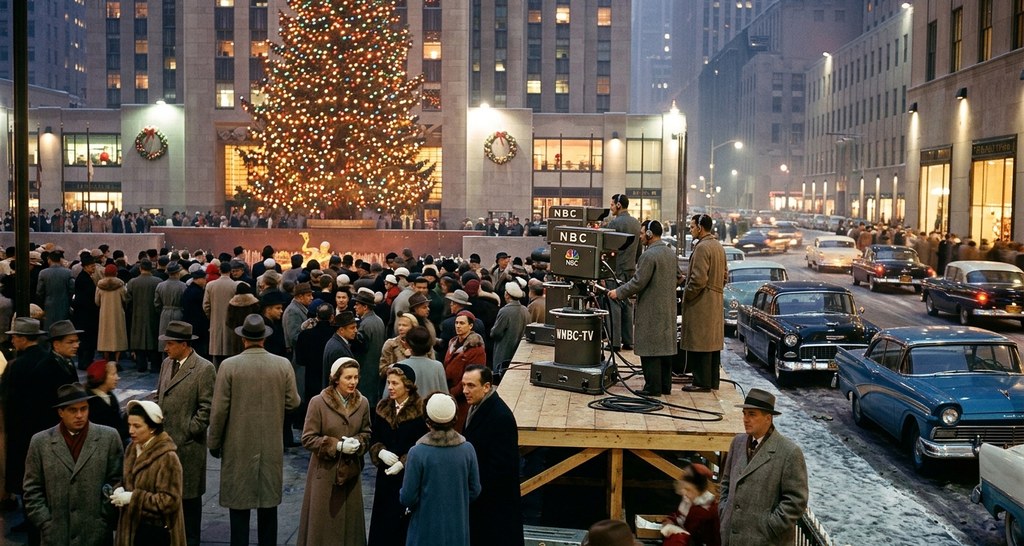
For nearly two decades, the Rockefeller Tree lighting remained a local New York tradition. That changed in 1951 when television brought the ceremony into American living rooms for the first time.
1951: The First Televised Lighting
NBC, which had its headquarters in the RCA Building (30 Rockefeller Plaza), broadcast the tree lighting for the first time on The Kate Smith Show in 1951. The broadcast was a novelty—television ownership was still limited, and the technology was new—but it marked the beginning of the tree’s transformation from local event to national spectacle.
From 1953 to 1955, the lighting ceremony appeared as part of the Howdy Doody television show, reaching children and families across the country. These early broadcasts were brief—often just a few minutes of airtime—but they planted the seed of the tree as a shared American holiday tradition.
The Modern Era: Christmas in Rockefeller Center
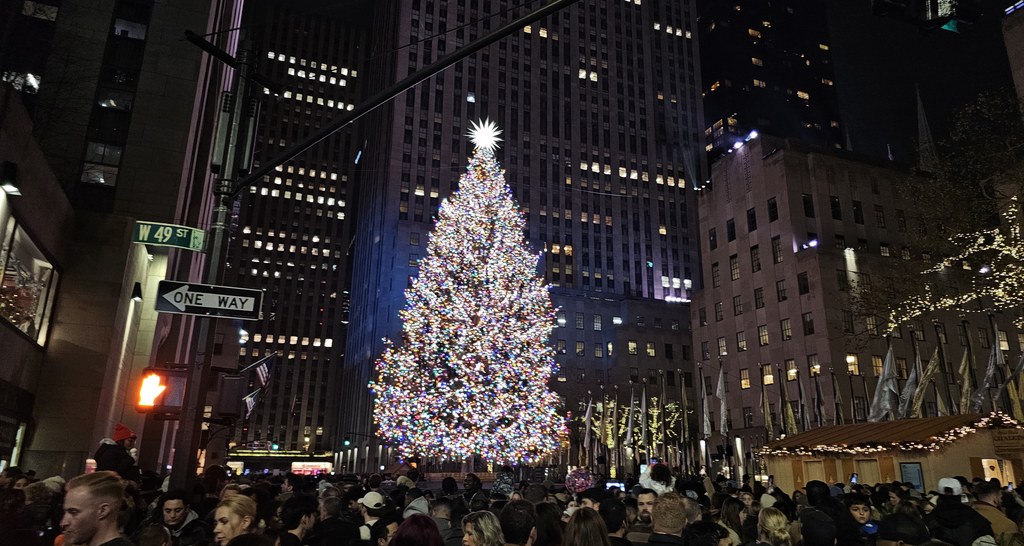
The modern format of the tree lighting—a primetime, multi-hour special featuring A-list musical performances, celebrity hosts, and elaborate production values—emerged in the 1990s. NBC’s Christmas in Rockefeller Center became an annual event, broadcast live from 7:00-10:00 PM and reaching tens of millions of viewers in the U.S. and hundreds of millions internationally.
Today, the ceremony is a cultural phenomenon. It signals the official start of the holiday season for many Americans, draws performers like Michael Bublé, Kelly Clarkson, and John Legend, and generates global media coverage. The tree lighting has transcended its Depression-era origins to become one of the most-watched holiday events in the world.
Local Tip: Plan your visit during off-peak morning hours (6:00–8:00 AM) or after 10:00 PM for the most serene tree viewing experience.
The Tree Itself: Specs, Selection, and Journey
Size and Species
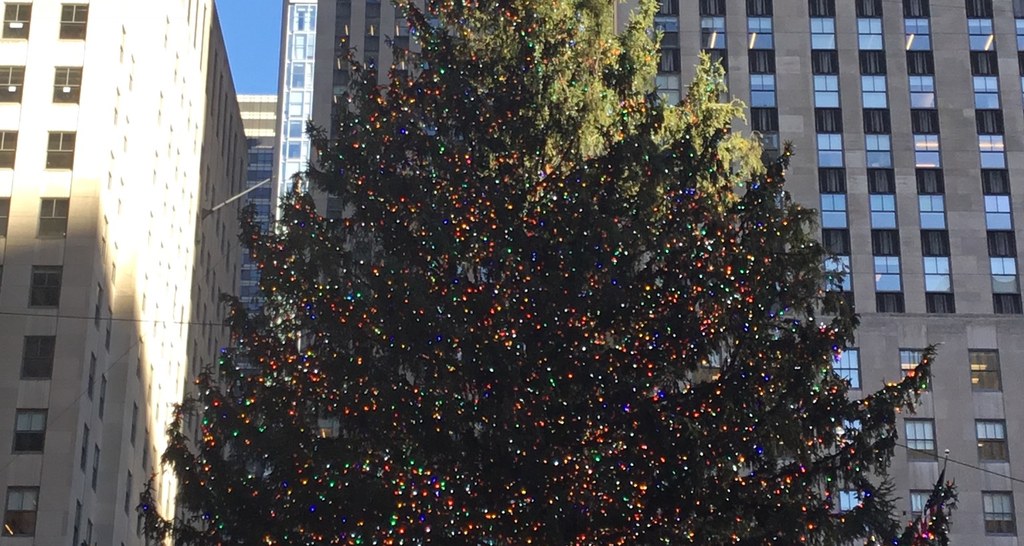
Modern Rockefeller trees are massive: typically 75-85 feet tall, 45-50 feet wide, and weighing 10-14 tons. The species is almost always a Norway spruce (Picea abies), chosen for its dense branches, symmetrical shape, and ability to hold thousands of lights and ornaments without drooping.
Norway spruces are evergreen conifers native to Europe but widely grown in the Northeastern United States. They’re hardy, fast-growing (adding 1-2 feet per year once established), and live 100+ years in ideal conditions. The trees selected for Rockefeller Center are typically 75-90 years old, meaning they’ve been growing since the 1930s-1950s—often predating the homeowners who eventually donate them.
How Trees Are Selected
Rockefeller Center doesn’t buy trees from commercial lots or tree farms. Every tree is donated by a family or property owner, usually after decades of growth in their yard. The selection process is part scouting, part word-of-mouth, and part luck.
Head gardener’s role: Rockefeller Center’s head gardener (a position held by only a handful of people over 90+ years) travels throughout the Northeastern U.S. each year looking for potential trees. Scouting happens year-round—driving past yards, following tips from tree services, and responding to homeowners who reach out suggesting their tree.
Criteria for selection:
- Height: 75-85 feet (taller is better, but the tree must fit within the plaza’s dimensions)
- Width: 45-50 feet at the widest point, with symmetrical branching
- Health: No disease, pest damage, or structural weakness
- Shape: Classic conical spruce silhouette, with dense branching from top to bottom
- Accessibility: The tree must be accessible by crane and flatbed truck (no trees hemmed in by buildings, power lines, or narrow streets)
Homeowner decision: Families who donate trees often have deep emotional connections to them—they’ve watched them grow for decades, their children played beneath them, and they’ve become landmarks in the neighborhood. Donating to Rockefeller Center is an honor, and homeowners receive a trip to New York to see their tree lit, VIP ceremony tickets, and the knowledge that their tree will become part of history.
The Journey to Manhattan
Once a tree is selected, the logistics are staggering. In early November (typically the first Saturday), a specialized crew arrives to cut down the tree, load it onto a custom flatbed truck, and begin the journey to Rockefeller Plaza.
Cutting and loading: The tree is carefully cut at the base using chainsaws, then lowered by crane onto the flatbed. Branches are wrapped in netting to prevent damage during transport. The entire process takes 4-6 hours.
The drive: The journey from the donor’s yard to Midtown Manhattan takes 6-10 hours, depending on distance and traffic. Past trees have traveled from Connecticut, Massachusetts, New York, Pennsylvania, and New Jersey. The truck moves slowly (30-40 mph) to avoid damage, and police escorts help navigate highways and city streets.
Arrival at Rockefeller Plaza: The tree typically arrives on a Saturday morning in early November, drawing crowds of onlookers who line the streets to watch the massive spruce navigate Manhattan. Once at the plaza, a crane lifts the tree into position above the ice skating rink, and workers secure it to a massive steel support structure anchored in the plaza floor.
Local Tip: Plan your visit during off-peak morning hours (6:00–8:00 AM) or after 10:00 PM for the most serene tree viewing experience.
Decorating the Tree: 50,000 Lights and a Crystal Star
The Lights: LED Revolution
The Rockefeller Tree is adorned with more than 50,000 multi-colored LED lights strung along approximately 5 miles of wire. Every light is individually placed by hand, a process that takes 2-3 weeks and requires workers to build scaffolding around the entire tree for safe access.
Why LEDs? Rockefeller Center switched from traditional incandescent bulbs to LEDs in 2007. The benefits are significant:
- Energy efficiency: LEDs use 75% less electricity than incandescent bulbs, reducing the tree’s environmental footprint.
- Longer lifespan: LEDs last 25,000+ hours, meaning fewer replacements and less waste.
- Less heat: LEDs produce minimal heat, allowing for denser light coverage without fire risk or tree damage.
- Brighter colors: LED technology produces more vibrant reds, blues, greens, and whites than old-style bulbs.
The lights are programmed to create synchronized patterns—twinkling sequences, color washes, and gradual fades—that enhance the tree’s visual impact. The lighting is controlled by a computerized system that runs the same sequence each night from lighting day through mid-January.
The Swarovski Star: Engineering Marvel
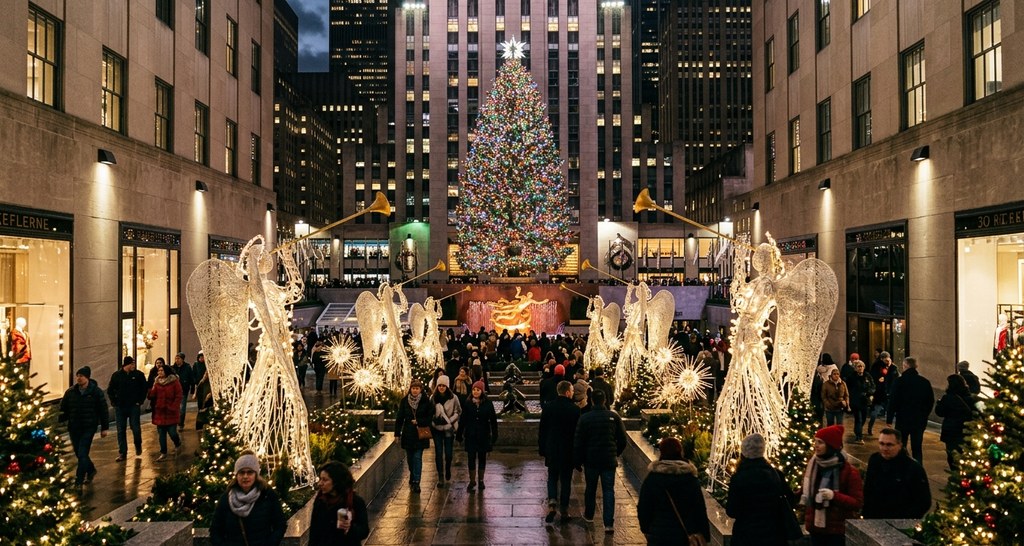
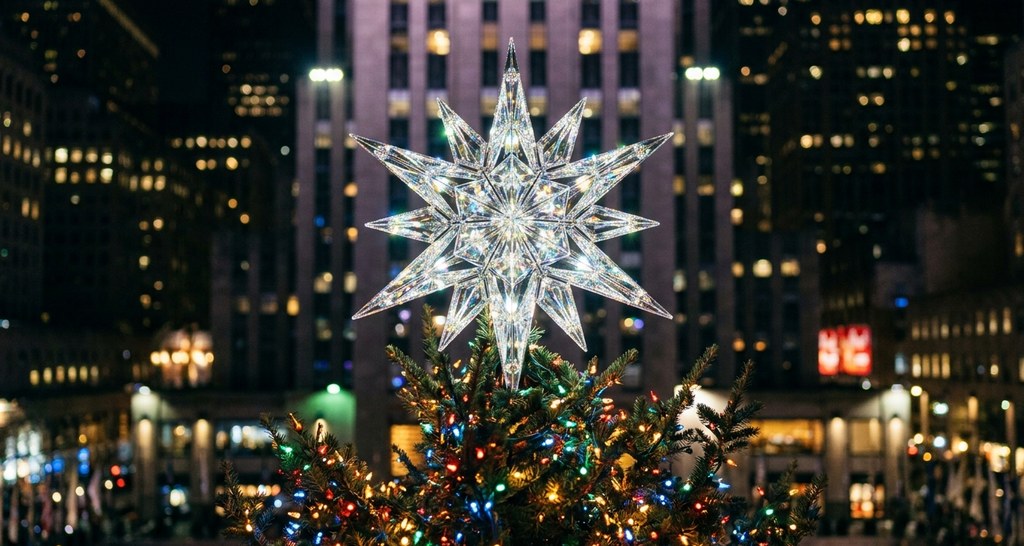
Atop the tree sits one of the most spectacular ornaments in the world: the Swarovski crystal star, designed by architect Daniel Libeskind and first unveiled in 2018.
Specs:
- Weight: 900 pounds (roughly the weight of a grand piano)
- Diameter: 9.5 feet (wider than most living rooms)
- Crystals: 3 million Swarovski crystals hand-set across 70 illuminated spikes
- Light output: 106,000 lumens (equivalent to 100 standard 100-watt lightbulbs)
The star is a three-dimensional sculpture, not a flat ornament. Each of the 70 spikes radiates outward, covered in precision-cut crystals that refract and reflect light in every direction. When illuminated, the star blazes like a supernova, visible for blocks in every direction.
Installation: The star is lifted by crane and secured to the tree’s peak in late November, just days before the lighting ceremony. It requires structural reinforcement—the tree’s top branches alone can’t support 900 pounds—so a steel framework is built into the tree’s upper section to distribute the weight.
The star replaces an earlier Swarovski design (2004-2018) that was smaller and less elaborate. The 2018 redesign by Libeskind, a renowned architect known for bold, angular designs, elevated the star from ornament to sculpture, making it as iconic as the tree itself.
Local Tip: Plan your visit during off-peak morning hours (6:00–8:00 AM) or after 10:00 PM for the most serene tree viewing experience.
After the Season: Habitat for Humanity Donation
The Rockefeller Tree’s legacy doesn’t end when the lights are extinguished in mid-January. Since 2007, every tree has been donated to Habitat for Humanity International, where it’s milled into lumber and used to build affordable homes for families in need.
How the Donation Process Works
Tree removal (mid-January): After the final day of public viewing, crews use chainsaws to section the tree into manageable pieces. The massive trunk and primary branches are loaded onto trucks and transported to a milling facility in New Jersey.
Milling: The wood is sawed into dimensional lumber (2x4s, 2x6s, plywood) suitable for home construction. Norway spruce is softwood, making it ideal for framing, interior walls, and finishing work. The milling process takes several weeks.
Branch chipping: Smaller branches and needles are chipped into mulch, which is distributed to Habitat construction sites for landscaping and erosion control. Nothing goes to waste.
Distribution and building: Habitat affiliates across the Northeastern U.S. (often in the same state the tree came from) receive the lumber and incorporate it into homes they’re building with and for low-income families. Habitat’s model requires future homeowners to invest “sweat equity”—working alongside volunteers to build their own home—making the Rockefeller Tree lumber a tangible part of the families’ journey to homeownership.
Families Who Receive Rockefeller Tree Homes
Families who move into homes built with Rockefeller Tree lumber often receive a plaque or certificate commemorating the tree’s legacy, connecting them to a piece of New York City history. For many, it’s deeply meaningful—knowing that the tree millions watched and celebrated is now the walls and floors of their home creates a sense of continuity and hope.
Past recipients have included single mothers escaping domestic violence, veterans returning from deployment, families rebuilding after natural disasters, and multi-generational households seeking stability. Habitat doesn’t give away homes—families must qualify financially, invest hundreds of hours of sweat equity, and repay affordable, no-interest mortgages—but the Rockefeller Tree lumber is a gift that makes those homes possible.
Why This Matters
The Habitat donation transforms the Rockefeller Tree from a temporary spectacle into a lasting force for good. It honors the tree’s Depression-era origins—when construction workers pooled their wages to create something beautiful amid hardship—by ensuring the tree continues to provide shelter and stability long after the holiday lights are extinguished.
It’s also a sustainability model. Rather than chipping the tree into mulch or incinerating it (common practices for large trees), Rockefeller Center ensures every usable piece becomes building material. The donation has inspired other cities and organizations to rethink how they handle seasonal trees, making sustainability and charitable giving part of holiday traditions.
Local Tip: Plan your visit during off-peak morning hours (6:00–8:00 AM) or after 10:00 PM for the most serene tree viewing experience.
Fun Facts and Record-Breaking Moments
Tallest Tree
The tallest Rockefeller Tree on record was a 100-foot Norway spruce in 1999, sourced from Killingworth, Connecticut. It was so tall that workers had to trim the top to fit within the plaza’s dimensions, making the final displayed height around 90 feet.
Smallest Tree
The smallest was the original 1931 tree at just 20 feet—smaller than many residential Christmas trees today. It’s a stark reminder of how much the tradition has grown.
Widest Tree
The widest tree measured 96 feet across at its base (2020), creating a nearly spherical silhouette. Workers had to trim and shape the branches to fit the plaza’s width constraints.
Lighting Duration
The tree is lit for approximately 6 weeks each year, from early December through mid-January. Over that period, the 50,000+ LED lights consume roughly the same electricity as running 10-15 average American homes for six weeks—a significant amount, though far less than the incandescent bulbs used before 2007.
Visitor Numbers
An estimated 500,000-750,000 people visit the Rockefeller Tree in person each season. Millions more see it on television, in films (Home Alone 2, Elf, countless Hallmark movies), and via social media.
Swarovski Star Cost
The 2018 Swarovski star reportedly cost over $1.5 million to design, engineer, and fabricate. Swarovski donates the star to Rockefeller Center, and it’s reused every year, making it a long-term investment in the tree’s iconic image.
Tree Age
Most Rockefeller trees are 75-90 years old, meaning they were saplings during World War II or the early Cold War. They’ve lived through generations of human history, only to culminate their lives as the world’s most famous Christmas tree.
Norway Spruce Lifespan Without Cutting
If left uncut, Norway spruces can live 200-300 years in ideal conditions. The trees chosen for Rockefeller Center are typically past their aesthetic prime (too large for residential yards) but still decades away from natural death, making the donation and repurposing a fitting end to their lifecycle.
Local Tip: Plan your visit during off-peak morning hours (6:00–8:00 AM) or after 10:00 PM for the most serene tree viewing experience.
Iconic Tree Moments in Pop Culture
Home Alone 2: Lost in New York (1992)
The most famous cinematic appearance of the Rockefeller Tree is in Home Alone 2, where Kevin McCallister (Macaulay Culkin) stands in front of the glowing tree, reflecting on family and the meaning of Christmas. The scene, set at night with the tree fully lit and snow falling, cemented the tree’s image as the ultimate symbol of New York holiday magic.
Elf (2003)
Will Ferrell’s Buddy the Elf visits Rockefeller Center in the film, marveling at the tree and the skating rink below. The movie’s climax involves Buddy saving Christmas, with the Rockefeller Tree as a backdrop. Elf introduced a new generation to the tree’s cultural significance.
Gossip Girl, Friends, 30 Rock
Numerous TV shows have featured the tree as shorthand for “It’s Christmas in New York.” From Gossip Girl‘s glamorous Upper East Side holiday episodes to Friends holiday specials and 30 Rock‘s satirical takes on the NBC building, the tree is a recurring character in New York-set television.
Proposals
Hundreds of proposals happen at the Rockefeller Tree each season. The combination of glowing lights, romantic ambiance, and the tree’s iconic status makes it one of the most popular proposal spots in New York City. Some couples book private ice skating chalets for intimate proposals; others drop to one knee in the crowded plaza, surrounded by strangers who inevitably cheer and applaud.
Local Tip: Plan your visit during off-peak morning hours (6:00–8:00 AM) or after 10:00 PM for the most serene tree viewing experience.
Common Myths and Misconceptions
Myth: Rockefeller Center Cuts Down Wild Trees
Truth: Every tree is donated by a private homeowner or property owner. Rockefeller Center never cuts down wild or public trees without permission. The tree has been growing in someone’s yard for decades, and the family chooses to donate it.
Myth: The Tree Is Fake or Partially Artificial
Truth: The tree is 100% real—a living (then cut) Norway spruce. No artificial branches, no fake sections. Everything you see is the actual tree, though heavily decorated with lights and ornaments.
Myth: The Same Tree Is Used Every Year
Truth: A new tree is selected and donated every year. Once a tree is cut down, it can’t be “replanted” or reused. Each year’s tree is unique.
Myth: The Tree Is Destroyed After the Season
Truth: The tree is donated to Habitat for Humanity and milled into lumber for building homes. Nothing is wasted.
Myth: You Need Tickets to See the Tree
Truth: The tree is free to view from Rockefeller Plaza from December 3 through mid-January. No tickets, reservations, or entry fees required. Tickets are only needed for the December 2 lighting ceremony VIP areas.
Local Tip: Plan your visit during off-peak morning hours (6:00–8:00 AM) or after 10:00 PM for the most serene tree viewing experience.
Frequently Asked Questions
When did the Rockefeller Tree tradition start?
The tradition began in 1931 when construction workers erected a small tree on the Rockefeller Center construction site. The first official lighting ceremony took place in 1933.
How tall is the Rockefeller Christmas Tree?
Modern trees are typically 75-85 feet tall and 45-50 feet wide, weighing 10-14 tons. The tallest on record was 100 feet (1999).
What kind of tree is the Rockefeller Tree?
Almost always a Norway spruce (Picea abies), chosen for its symmetrical shape, dense branches, and ability to hold thousands of lights.
How many lights are on the Rockefeller Tree?
More than 50,000 multi-colored LED lights, strung along approximately 5 miles of wire.
What is the star on top of the tree made of?
The Swarovski crystal star weighs 900 pounds, spans 9.5 feet in diameter, and contains 3 million crystals across 70 illuminated spikes. It was designed by architect Daniel Libeskind in 2018.
What happens to the tree after Christmas?
Since 2007, every tree is donated to Habitat for Humanity and milled into lumber for building affordable homes. Branches are chipped into mulch.
How is the tree chosen each year?
Rockefeller Center’s head gardener scouts the Northeastern U.S. for suitable Norway spruces, looking for height, width, symmetry, and health. Families donate their trees, and homeowners receive VIP ceremony tickets and a trip to New York to see their tree lit.
Can I donate my tree to Rockefeller Center?
If you have a Norway spruce that’s 75+ feet tall, 45+ feet wide, symmetrical, healthy, and accessible by crane/truck, you can contact Rockefeller Center’s gardening team to suggest your tree. Most trees are scouted proactively, but homeowner suggestions are considered.
Read our full Rockefeller tree lighting guide for visitor essentials.